 In a world where appraising bicycle-related exotica often means yakking on about history and tradition in an overtly Eurocentric manner, one man has dared to be slightly underwhelmed by a Pegoretti and enamoured by an Australian frame builder. Now Rich Gearing has hopped it to a new life Down Under with his fiancée Wendy (there they are, pictured on the right at their farewell do in a Whitehall pub) and a substratum of London’s cycling scene will be a poorer place for his absence. Rich is a fellow member of London Dynamo, a unique club whose past and present members have given us For Goodness Shakes, Rouleur and Look Mum No Hands. And I like to think Brain Farts Of A Bike Tart follows that Dynamo ethos of taking an original idea – in this case an inquisitive and highly personalised take on bike bling – and making it part of cycling’s cultural landscape. So I’d like to take this opportunity to wish him and Wendy all the best. Here’s to many more farts, pal!
Posts Tagged ‘Cycling’
Bye bye, Bike Tart
March 27, 2012South Kensington: a land of contrasts
March 19, 2012This post is about a few things I see on my bicycle ride into town. No, no – wait! Come back! It won’t be that dull! Or at least I’ll do my best to make sure it isn’t.
Firstly, I would like to introduce you to a prime candidate for Trades Descriptions: Invisible Menders of Knightsbridge.

For a start, it’s in South Kensington, not Knightsbridge. And, as you may have noticed from the orange and brown frontage, the shop is not invisible. I mean, honestly – how could they have got away with this for so long? It’s a complete misnomer on every conceivable level.
In another sense, though, Invisible Menders is invisible, because after stopping hundreds of times at the traffic lights on the junction of Old Brompton Street and Gloucester Road, I have yet to see anyone startled by the façade or the yellowing signs with their jaunty, cursive typeface. It just sits there, unremarked-upon, a wonderful incongruity that must be around half-a-century old.
By contrast, just a few pedal-strokes away, Exhibition Road has begun making quite an exhibition of itself.
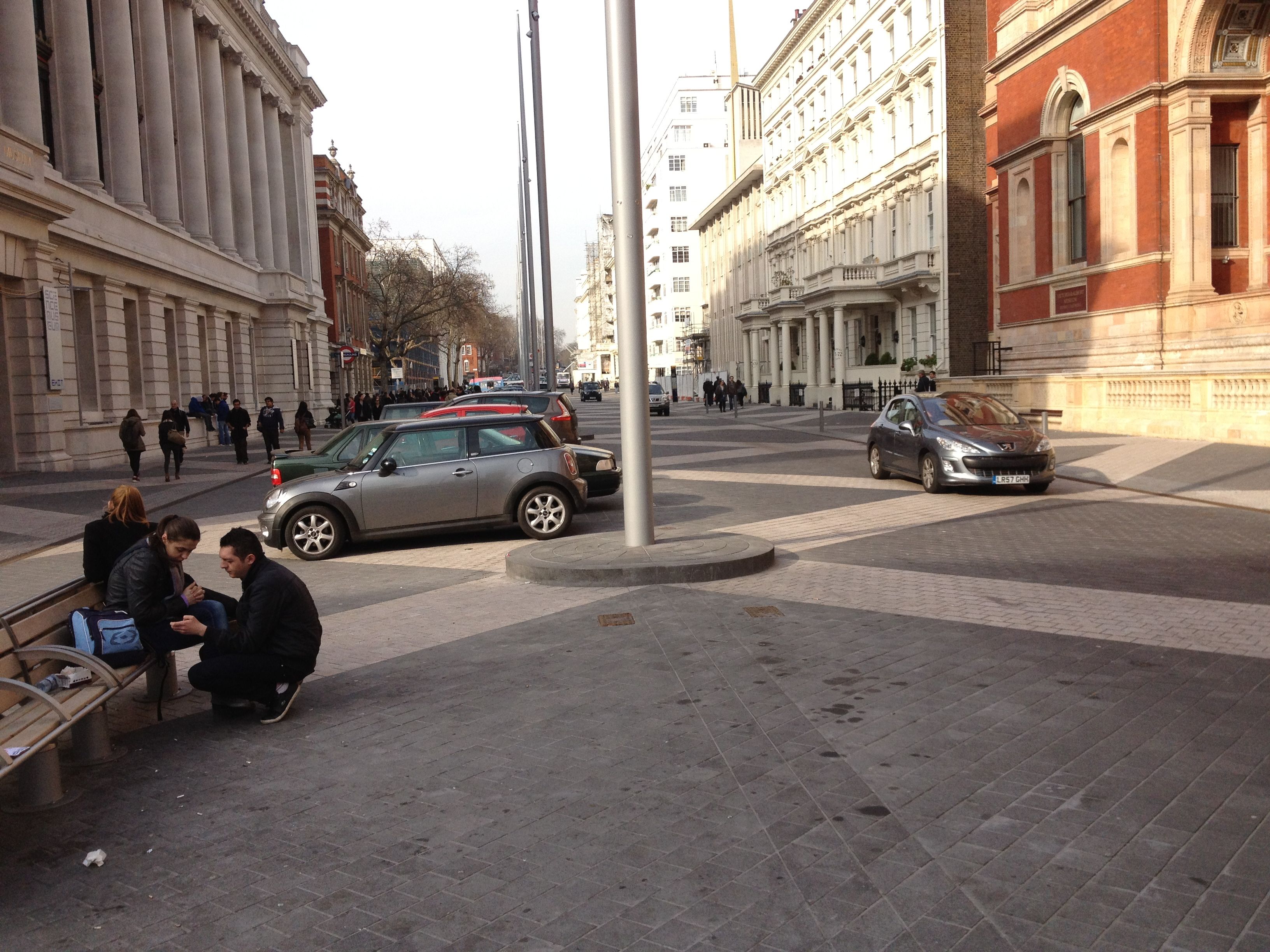
Look! No curbs! No tarmac! And no-one travelling at more than 20mph! Personally, I like the grand social statement it’s making: humans, regardless of whether they walk, cycle or use a motor vehicle, can all share the same space safely. And the chap on the left is so comfortable with these new surroundings he has squatted down to fondle his companion’s leg. An extraordinary scene, I’m sure you’ll agree.

The road planners of Kensington and Chelsea have also pedestrianised the junction of Old Brompton Road and Pelham Street, which is right outside the entrance to South Kensington station.

What you can see in that photo is a cab driver taking care not to hit two pedestrians. What you can’t see, because it happened about a minute before I took the picture, is me turning left into the junction with a big grin on my face because I no longer have to shout “WAKE UP” at someone walking blithely into my path without looking right. I’m not a psychologist, so I don’t know why removing a curb makes people more aware that they are stepping into traffic, but in my experience, it works.
So there you have it: one inconspicuous old novelty, and two conspicuous new ones. And I take hope from what the former could say about the latter: if you fulfill a purpose quietly, invisibly, then you’ll be around in 50 years, too.
Apple’s greatest thingamyjigs
March 9, 2012Over the years, I have owned and used many items emblazoned with the familiar silhouette of a bitten apple. But my two favourites are probably the least technologically advanced, which is probably why their praises aren’t sung too often. So I would like to offer my own faint warble to them here.
The first device which holds a special place in my heart is this little marvel:

It looks like a Nano that’s grown a tail, but it’s actually an FM radio. Plug it into the old version of the iPod and the screen becomes a transistor receiver dial.

Now, doesn’t that look nice?
I’ve written before about my unbounded love for Danny Baker’s show on BBC London 94.9, but without this beauty, I wouldn’t be able to indulge in the simple pleasure of listening to the great man every day while I cycle into town. Having used the TuneIn app, I’ve learnt that radio via 3G is simply a means of disturbing your listening pleasure with random silences, and I’ve heard that DAB radios have the same problem. So for the foreseeable future, I’ll stick with this fantastic analogue oddity.
My second thing of wonder is the remote control for the iMac.

It enables you to adjust the volume, pause or skip tracks, and switch playlists or albums. All of which you can do with a mouse or a keyboard, but not when you’re slogging away on the turbo and you suddenly realise that you need to go one louder or change to a completely different playlist if you’re going to last until the end of the session. Essentially, by combining this simple infrared device with a pair of good speakers, you’ve turned your Mac into a less fiddly, turbo-friendly iPod.
Yes, these wotsits are merely accessories, humble sequins on technology’s shimmering raiment. But rather than launch the third incarnation of the same tablet in less than two years, I really wish Apple would instead come up with more of these unusual objects. The sort of objects that say, “I can fit neatly into your life,” not “Fit all of your life onto me.”
Let’s not shake on it
December 31, 2011
If you and I were to meet, I wouldn’t want to shake your hand. Because I’d like us to have an enjoyable time together, and shaking hands implies we’re not going to have any fun whatsoever. To me, a handshake at the beginning of an encounter means, let’s get this over with; at the end, that’s it – we’re done. A formula for formality, a handshake can extinguish a friendship before it has even begun.
It is now the season of The Handshake. Colleagues wish me a merry Christmas, or a happy New Year, or both, by offering an outstretched palm. This is when a shake of the hand becomes an expressive gesture, a means for people who aren’t quite friends to express a friendly sentiment. But during the rest of the year, I experience the mundane oddness of handshakes. I arrive at training rides or races, and cyclists – good friends, men I have known for years – offer to shake my hand, even if they last saw me only a few weeks before. It’s as if we’re pretending that these meetings are planned, when they invariably occur by chance. Or maybe, by doing something with our upper bodies, we’re each compensating for being stuck in a half-standing, half-sitting position with a bicycle between our legs.
Four months ago, I sat in on a meeting with an author and an editor friend of mine. I didn’t need to be there, but I went along because I had helped set up the meeting (I liked the idea the author had for a book and I guessed, correctly, that my friend may be interested in publishing it). The author is physically disabled, and his carer was the only woman present. At the end of the meeting, the men were all shaking hands, and I thought I’d better join in. So I turned to the carer, who was at least ten years younger than me, said, “Nice to meet you,” and offered my hand. She was taken aback – so taken aback, in fact, that she gave me what I can only describe as an ironic handshake, delivered slightly slower than everyone else’s and with a smirk. I have made it my mission to do the same at least once in 2012.
Let’s meat the Liquigas team
December 20, 2011
We’ve reached the point on the calendar where it’s traditional to make some sort of lofty judgment about the past 11-and-a-bit months – and so, in keeping with the annual mood of inexpert opinion stridently expressed, I am declaring 2011 to be The Year We Learned Too Much.
The basis of my flimsy theory is as follows: the fug of mystery and inscrutability which surrounded the noble profession of bicycle racing for generations has now been dispersed by the mighty wind of tweeting, which has enabled a once-enigmatic breed of sportsmen to communicate many mundane details of their lives. Perhaps the high point of this phenomenon took place in June when Mark Cavendish momentarily forgot he had problems with his water supply and thoughtlessly left a deposit in his lavatory. I chortled, and so, I imagine, did many of his 196,000 followers. But could you imagine, say, Eddy Merckx explaining why he had trouble flushing, or an embarrassed Fausto Coppi telling the White Lady to “leave it for 10 minutes, love”? Like the now-departed Kim Jong-il, these legendary men were probably above that sort of thing.
The cycling heritage industry would have us believe that the black-and-white era was the golden age of mystery. In those monochrome photographs, dapper men pedal remorselessly through their pain, their visages giving barely any clue to the mental processes and diabolical thoughts that forced them to reach the finish line. But for me, the archetype of enigmatic cyclists reached its apotheosis much more recently. It occurred in 2009, and its sole manifestation was the uniquely enlightening website of the Liquigas team.
By some miracle of history, the website still exists, and under the heading “Curiosities” you will find details about each team member which are truly curious. Take, for example this revelation concerning Murilo Fischer:
Favorite dish: Meat
That’s right: meat. Just meat. Meat. And, from that one fascinating detail, we are able to conjure up carnivorous Fischer’s wretched existence. Caged and naked at the team’s hotel, the ravenous, snarling Brazilian growls the only word of English he knows. “Meat.” He lies in wait every night for the moment when the rusty door of his cage creaks open and his handler throws a slab of raw steak, or a bucket of pork chops, or whatever else the Liquigas chef can find to appease his insatiable appetite. For he is Murilo Fischer, and he must have meat.
Yes, you may consider that scenario to be somewhat far-fetched. Maybe you would argue that the vague term “meat” is actually code for “mystery meat”, a tacit admission that he enjoys dubious foodstuffs frowned upon by his fellow pros, such as late-night kebabs and Asda own-brand sausages. And that may well be the case. But the truth is lost in the mists of time. We, and future historians, can only speculate.
Elsewhere in the Great Liquigas List Of Curiosities, Roman Kreuziger is giving very little away about where he chooses to spend his vacation:
Favorite holiday resort: The sea
One can picture the Czech transfixed by a blanket of shimmering blue as he sits on an otherwise unremarkable beach. That image remains with him always; it is a reminder of a pleasure denied to him in his landlocked home country. Then, many years later, he is asked by a Liquigas employee charged with creating the team’s website where he likes to go on holiday. Roman smiles at the seemingly humdrum question. His gaze is distant. Finally, he breaks the silence: “The sea,” he whispers. “The sea…”
Kreuziger’s teammates Kjell Carlström and Maciej Bodnar list their hobbies as “computer” and “internet” respectively, although we can probably guess why two chaps spending many nights away from home would want to be vague about what they get up to on their laptops. But perhaps Ivan Basso had a more urgent need to be circumspect in 2009: this, you may remember, was his first full year of competition following his two-year doping ban – an event precipitated by the revelation that bags of stored blood were code-marked with the word “Birillo”. If someone hadn’t alleged that this was the name of the Italian’s dog, who knows how the case would’ve panned out? So this time, Basso gives nothing away: his list of curiosities is entirely blank:
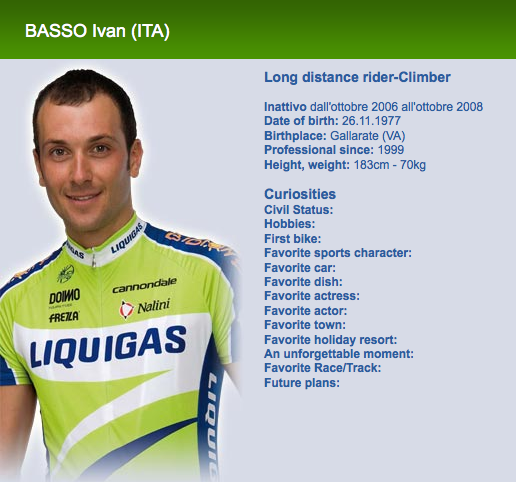
We all think we know Ivan Basso. But no one knows the real Ivan Basso. His only curiosity is this: he has no known curiosities.
Curious.
A happy scene you seldom see
November 23, 2011“Hello there! Would you mind awfully just winding down your window for a moment?”
“Certainly! What seems to be the problem?”
“Well, you drove just a teeny-tiny bit to close to me there.”
“Ah. Yes. Now you mention it, I think I probably did.”
“And as we’re now both waiting here at the traffic lights, I thought I’d mention it while I had the opportunity.”
“Yes. Good idea.”
“Just to avoid it happening again. Because it’s quite scary when a ton of metal looks like it’s going to knock you down.”
“I can totally see your point, sir. My apologies. I’ll try to be more considerate next time.”
“Thanks.”
“But I must say, this situation is most unusual.”
“Really? In what way?”
“Well, it’s just so… civil. Cyclists tend to get very angry about getting cut up.”
“Ah, yes. Well, you see, I was going to lose my temper. But then I read something about moments like this. Apparently I’m supposed to show love. ‘Smile in the face of thoughtlessness,’ it said. ‘Explain the terror of being cut up. Tell them you are scared.’ I had my doubts, I must admit, but it seems to have worked on this occasion.”
“Hmmm. Yes…”
“Oh dear. Was that a little patronising?”
“Oh no no no. Not at all. Well, maybe a little. But that’s not what perturbs me. It’s this conversation. It should be angry, fractious, unreasonable, neither of us giving any quarter. It’s not real enough. In fact, I would go as far to say that it’s not even happening.”
“No! I will not have it, sir – I simply will not have it! Look, if what you’re saying is true, then this entire situation has been fabricated. But look at that red light! Any minute now it will turn green, and that will prove we’re actually here.”
(They look. They wait for a considerable time. The traffic lights remain red.)
“Oh well. Looks like you were right.”
“Sorry, old boy. If it’s any consolation, it seems that both of us are merely providing a cipher for the author’s thought process.”
“It would seem so, yes. I am not the autonomous being that I thought I was. I may as well just give up now. Which is a shame, because I had so much I wanted to say.”
“Well, why not say it? You’ve got nothing to lose.”
“You say that, but that’s not quite true. Because I met the guy who wrote that blog post…
“You met him?”
“Yes, I met him. Because we’ve already established I’m the author, not a creation in a fictive contrivance.”
“Ah yes. I see what you mean.”
“So I don’t want to cause offence. He had a nice little dog and he seemed like a nice chap.”
“But you disagree fundamentally with his reasoning on this occasion.”
“Yes! Completely!”
“Because he characterises the relationship between drivers and cyclists as essentially confrontational, whereas you believe it isn’t.”
“Exactly. I mean, it can be confrontational, but only on the relatively few occasions when things go wrong. But the vast majority of drivers let us get on with it. They like us – or they tolerate us – but they don’t hate us, and I generally don’t hate them. It’s a false opposition. And isn’t the tone of his reasoning is a bit vain? Look at me! I’m mastering my anger – and you should too! We can have a better society, but only if you’re all a little like me!”
“So what’s the solution? More angriness?”
“No. Not more anger, or showing more love. Just more, I don’t know, practicality. Boring things, like joining the CTC or the London Cycling Campaign, writing to your local council asking them to improve conditions for cyclists, maybe telling your MP you want to see stiffer sentencing for bad drivers. Stuff like that.”
“I think you’ve made your point quite eloquently.”
“Thank you.”
“But the bad news is that in doing so, we have now served our purpose.”
“Oh.”
“So I wouldn’t be at all surprised if we expired right this very second.”
“I think you may be right.”
(Predictably, they vanish.)
Dynamightgiveitamiss No.5: La Gazzetta Della Bolshie
March 14, 2011UPDATE 19/05/11: It’s taken almost two months, but the Lambsters have finally found this post, and The Berk himself has responded on his blog and Twitter. Apparently I’ve accused him of exploiting his illness for financial gains, I’m a stalker, I want him to shut up and, er, I’m fat (ooh, you BITCH). Of course, none of these statements is even remotely true. Especially the stalker bit – I couldn’t think of anything worse than having to meet The Berk. But this is what angry, slightly dim people do: they make stuff up because they want a fight. And I don’t. Which is why, as I said in my original post, I’ve left the whole pointless world of Dynamoaning behind…
Simon Lamb is a berk. It’s an insult to anyone who is bipolar to dismiss them as simply mad or argue that they are never capable of behaving rationally, or that they have lost the ability to reflect on their actions and own up to their mistakes, so Simon Lamb’s berkishness has absolutely nothing to do with his well-documented condition. (Having said that, the charity Mind might want to consider the wisdom of promoting him in the press as an ambassador for the tolerance and understanding of mental health issues when he demonstrates so little of those two qualities towards those whose unhappiness differs from his own.) But he is unquestionably a berk, and he is a berk for many, many reasons. So if you don’t know or care who Lamb is, now is the moment to bail out of what is going to be a very long post…
For a start, Lamb is a berk because he earned himself a legal warning for branding a blameless journalist a racist without offering any evidence whatsoever to back up his claim. The British writer, he alleged, didn’t give Lamb’s banned hero Alexander Vinokourov a chance to explain himself – a bizarre claim in light of the Kazakh’s unwillingness to offer any sort of credible explanation for his positive doping test. And while I wouldn’t call Lamb a racist, I think he’s a massive berk for not considering that in comparison with the argument about Vino, most people are more likely to raise an eyebrow when a bloke casually uses the phrase “fucking Jews” while tweeting one of his mates.

There’s more, of course. Lots more. Lamb is a berk because he made an unfunny remark about how he would like to see Pat McQuaid die and didn’t apologise when the UCI president’s son politely complained. He’s a berk because his appropriation of a cancer foundation’s logo for his own glorification and, as it appeared to at least one casual observer, seemingly for his own financial gain, was spun into a sentimental story of little-guy-hits-back-at-humourless-legal-bad-guys with, preposterously, none other than Lance Armstrong lurking in the background. He’s a berk for casually mentioning that sales of his massage oils, while perfectly in line with the benefits system he relies on, have funded his sports massage course after originally claiming his website is “purely for my interest in cycling”. He’s a berk when you consider his lofty motto of “calm is the virtue of the strong” is hilariously at odds with the size of his hate list, which includes David Millar, a number of specialist sports magazines, a certain member of Kingston Wheelers cycling club, the Daily Mail and the BBC (surely a unique double-whammy), and, of course, his bete noir Armstrong. And he’s a berk for attacking Shutt Velo Rapide when the fledgling clothing manufacturer allegedly suffered quality control problems with his jerseys and he didn’t get his way on pricing and copyright issues. (Incidentally, Lamb’s beloved Rapha also had quality control issues in its early days which it resolved, and the company now occasionally sends him free gear to review. And the now-defunct website Lamb used to attack Shutt was Velocast, who seemed to be quite happy with their jerseys, which were made by none other than… Shutt Velo Rapide!)
Simon Lamb is a hopeless, floundering, fulminating berk for all of these reasons, and that is enough in itself for La Gazzetta Della Bici, a landfill site for his petty vendettas, cycling-based trivia and uncaptioned photos of dead sportsmen to make my list of things that are the absolute antithesis of this blog. (Incidentally, what kind of egotistical berk appropriates the name of a famous newspaper just to get a few more hits?) But for me, his biggest act of berkishness was when he found out where a complete stranger worked, sent him an abusive message, and accused him of saying something he didn’t. But I would say that, wouldn’t I? Because I was that stranger who stumbled unwittingly into the weird world of Simon Lamb, an angry man perpetually on the lookout for a fight, and in doing so falling far short of the high standards he sets for others.
In May last year, Lamb discovered I was a member of a cycling club he irrationally despises and used this as the flimsy basis to wrongly claim on Twitter that I wanted him to “shout” (sic) his mouth. (A lovely, prophetic irony: I wouldn’t want my worst enemy to shut his mouth – if I had a worst enemy – but I would love him to shout, and shout his mouth off for as long and as loudly as he could, just so he can prove to as many people as possible what a gigantic idiot he actually is.) The previous night, Lamb had blogged in characteristically intemperate and exaggerated terms about a friend of his who he claimed was bullied by a group of London Dynamo riders on the Parkride, the club’s regular Saturday morning outing in Richmond Park. At the time, Lamb had more than a thousand followers, and the link was retweeted at least a dozen times; understandably, then, there was much anger about the incident, particularly as Lamb’s friend and her mate were female and novices, while the Dynamo riders who were said to be shouting at them to move as they went past (which is what the alleged bullying amounted to) were apparently experienced riders and male.
There were just two problems: the specifics of the incident, in the terms Lamb described them, in all likelihood didn’t take place, and he wasn’t there at the time (to this day, no one seems to know who those Dynamos were). The woman, perhaps realising what had actually happened during those fraught moments at that particular road’s busiest time, or maybe concerned at Lamb’s disproportionate anger, apparently got him to call off the dogs after a few days of his unedifying swear-packed tweets, which he had used to propose a ludicrous theory that the majority of Dynamos let the minority get away with pushing around other riders – in other words, fostering a culture of bullying. Behind the scenes, a number of reasonably well-known London-based cycling bloggers were distancing themselves from Lamb’s remarks, and a respected journalist from a bike magazine (not the one he would later brand a racist) expressed his concerns, prompting Lamb to award him the sobriquet of… well, it begins with a “c” and he uses it a lot, so you can probably guess. But it was some subtle diplomacy from the guys who run the club that really did the trick – and so, without his friend to publicly back up his dramatic claims, Lamb turned down an offer to meet the Dynamo committee and removed all the relevant posts from his blog before tweeting a lame warning to the “cowards” in Richmond Park. Ironically, given his readiness to brand other people cowards, that tweet was also later deleted – a common occurrence in the world of Lamb, and the reason I began screengrabbing so many of them. Unfortunately, his deleted blog posts weren’t quite as perishable: they were picked up by another blog, which you can still find with a bit of googling.
London needs Dynamo, despite all its imperfections. Before it began, club cycling in the capital was a closed-off world to anyone who wanted to join the sport (I know because I was one of them), and its club rides still attract scores of cyclists of all abilities throughout the year. But to internet-dwelling wingnuts such as simple Simon, it matters little that Dynamo has welcomed hundreds of people into the sport he supposedly loves, helped them become decent cyclists, and become an actual, real-life community of friends. It also doesn’t matter to them that its committee acts as a means for ordinary cyclists to express their concerns to the authorities dealing with Richmond Park (you have LD partly to thank for partially resolving the horrid resurfacing) or that a committee member recently persuaded the owners of the much-loved MoD track in Chertsey to reopen it for a one-day trial run. Neither do they care that the club takes a very dim view when its members genuinely fail to ride with consideration and care for others. Lamb and others like him see the oft-quoted figure of 400 members and simply equate big with bad. Their attacks follow a tried-and-tested formula: make a false or exaggerated claim on the internet, maintain a level of anonymity by declining the offer of a face-to-face chat and a coffee (easy to set up, given that most of the friendly committee and the faceless complainants are both usually in Richmond Park on Saturday mornings) and fantasise about physically attacking a Dynamo or, in a particularly nasty case on the wretched Veloriders forum which has since been deleted, seeing one of them die. In the face of ever-increasing membership numbers, they also ignore a simple question: why haven’t members left the club in droves if they’re supposedly surrounded by a bunch of arrogant bastards? Wouldn’t you leave if that was the case? Maybe Dynamo has become big in a relatively short space of time because it’s friendly and well-run – or is that statement just too straightforward and logical to comprehend?
And whatever half-baked theory the haters propose, there are numerous sensible counter-arguments. Yes, I’m sure some Dynamos have shouted at other cyclists and switched wheels, but then I’ve witnessed riders from other teams and clubs do the same for years. Yes, poor bike handling has been a feature of LD rides, mainly because a greater proportion is inexperienced in comparison to other large clubs, yet Dynamo’s safety record in relation to the number of miles covered is nevertheless excellent. Yes, it can be intimidating when an experienced group of ‘Mos passes you at speed, even though they endeavour to do it safely – although for every rider who complains we’re going too fast, another will say we’re going too slow. And yes, Dynamos have, regrettably, sometimes been witnessed behaving aggressively when commuting, but then the blue, black and orange tops are a commoner sight than other clubs’ jerseys on London’s streets. (A pertinent, if somewhat vain fact: the look of Dynamo’s kit is one of the most popular reasons members give for joining, which could mean that in comparison with other similar-sized clubs, Dynamos are more likely to wear club colours when not riding with their clubmates.) In truth, Dynamos aren’t ruder than anyone else, nor is there a greater likelihood of them breaking the rules; there are just more of us, and we’re more conspicuous.
Lamb, however, differs in two respects from your typical Dynamo-hater. Firstly, he may not have only fantasised about violence, if his claim that he was a member of a group of football hooligans called the 6.57 crew is anything to go by. And secondly, he is now attempting to show us all how things should be done by starting his very own cycling club – and in the words of one of his internet chums which he was only to happy to use as promotion for his new venture, it’s the “polar opposite” of the outfit which has had such a Lambasting.
Men and women’s racing teams, strong representation at sportives, a website functioning as a virtual clubhouse, weekly club rides and members of all abilities (some of whom are based overseas), not to mention supporting good causes… Gruppo Sportivo Gazzetta’s list of aims is notably ambitious and, perhaps not co-incidentally, somewhat similar to what London Dynamo has already achieved along the way. Indeed, GS Gazzetta, to use its slightly less cumbersome appellation, also seems to share a core Dynamo value in the sense that Lamb realises the importance of having well-designed kit, although the pre-release photos reveal he’s played it a little too safe with an uninspired, Rapha-lite, white-on-black design. Nevertheless, the Gazzas do, as Lambster Tom claims in the above link, represent a real difference to the club I’ve been a member of since its inception, so much so that they may as well be called Not London Dynamo, which would at least be less of a mouthful. And the difference with Not London Dynamo is this: its two leaders, for all their enthusiasm, appear to be remarkably inexperienced riders. Having ridden myself with Lamb’s chum Teresa Houghton and spoken with a friend who rode the London to Paris with her, I would suggest that her focus on spin classes has had a detrimental effect on her ability to develop group riding skills. Lamb, meanwhile, had been riding for barely more than a year when he fractured his left arm and collarbone and wrote off his bike on Not London Dynamo’s first-ever ride last November. In terms of serious accidents per total miles travelled, the Gazzas immediately became a more crash-prone club than London Dynamo before it had even officially accepted its first membership application. Quite an achievement.
Contrast Not London Dynamo – essentially a group of strangers who met on the internet – with the pedigree of London Dynamo’s founders: an accomplished time trialist (Guy Andrews), a talented former BMXer (Russell Short) and a pretty handy road racer (Paul Callinan). That’s a huge range of skills to pass on, especially to the fat, clueless novice I used to be, and of much more practical use than, say, the ability to crow about owning Michael Barry’s hat collection. As far as I’m concerned, Not London Dynamo doesn’t deserve to call itself a cycling club unless it can develop skills and encourage safe riding, because that, essentially, is the true value of the club system. But I wouldn’t hold your breath: contradicting the official rules on the Gazzas’ site, Lamb himself apparently wants his “club” to ignore the two abreast formation fundamental to safe riding because they are supposed to be a “rabble”. He expressed this view a week after coming off, so his accident may have been caused by more than just an error on his part. If that’s the case, the haters will now have another bunch of riders to moan about, perhaps with good reason this time. If they don’t, well, there’s plenty of other reasons to take issue with Lamb, and that could be why he shut down his personal Twitter account a few weeks ago: get off the stage before the audience turns and the rotten tomatoes come flying your way…
I wrote all this for two reasons. Firstly, terms such as “bloody Dynamos” have become the equivalent of “bloody cyclists” for people who ride a bike but are now just as intransigent as the type of motorists all riders dislike, and while I no longer enjoy poking fun at these idiots for using the club I love as their personal punchbag, I couldn’t walk away from these pointless arguments for good without setting the record straight. Secondly, there is virtually no criticism of Lamb online, which is a marked contrast to many of the face-to-face conversations I’ve had during the past ten months, so I wanted to redress that balance in a small way on this little blog – and for the record, I honestly harbour no desire to rival Lamb’s online presence. Given his previous form, Lamb will probably resort to name-calling and dredge up aspects of my life that have little or nothing to do with cycling; maybe he’ll even trawl through my tweets and falsely reason that some of the opinions I express chiefly to my friends are the same as his targeted, vitriolic hate campaigns. But hey, that’s his call, and a measure of his class or lack of it. Either way, I’m not going to mention his name in these pages ever again, and this entry won’t be open for comments – I’ll leave the half-truths, backbiting and exaggerations for his blog.
If you want to support Mind, you can avoid the Gazzas by donating money to the organisation directly. As for supporting young riders, I would recommend you have a look at the John Ibbotson Fund, or maybe even consider entering its auction for Rouleur issue #1. And here’s a final thought to any Lamb fans – and there appears to be many of them – who believe he should remain beyond criticism because of what he’s been through: some defenders of Armstrong say much the same thing about their hero. Do you think, maybe, that Lamb is using mental health issues in a similar way but on a smaller scale to that which many think his hate-target uses cancer? Because if he is, then Lamb isn’t such a berk after all…
Follow @campbells_snoopSaturday blight
March 5, 2011I received a comment about my post on the ropy Ian McEwan novel Saturday this week, and my instinct was to hit the delete button because I knew the nitwit who wrote it had arrived at this blog for a very different reason. Then I realised I may not ever get a chance to publish anything quite so daft ever again, and it sort of ties in with what I’ll be writing about in my next post. So here, for your enjoyment and mine, are the words of some tit called Christopher Parkman in all their glory…
“How else dear boy is a character not going to have a thought ‘artificially placed there by the dullard narrator’? He isn’t real, it’s a novel, the clue is in the word ‘fiction’.
“Have you even read any Woolf? She practically invented that type of leaden psychological prose. What the fuck does expatiation mean anyway, do you mean expiation? You know what I hate? When people use long words that they don’t understand to try and make themselves look clever. Anyway I’m sure that you know better than Salman Rushdie, Clive James and Martin Amis who all regard McEwan as one of the best writers of his generation.”
Well, I was hardly challenging McEwan’s reputation, just expressing an opinion about one novel in particular which even some of his fans seem to think is a bit of a stinker (see comments). Full marks for noticing that “fiction” is stuff that’s made up, but this isn’t just fiction: it is considered to be literature, so it is supposed to use artifice to express some sort of higher truth or insight. To me, Woolf does this and Saturday doesn’t. As for “expatiation”, the word means to write in great detail, which the author does regarding the unease and conflicting opinions of the British public prior to the war with Iraq. “Expiation”, on the other hand, is atonement, which I gather is another of Mr. McEwan’s novels. Still, at least we can agree on one thing: it is annoying when people get unusual words wrong, isn’t it, dear boy?
Having said all that, I don’t think Christopher Parkman actually meant any of the badly-formed thoughts he thwacked into a keyboard with his limp, pudgy paw. Because the fact is, he called me, my friends and acquaintances “c*nts” on Twitter for no good reason, then came over here after I blocked him. So I reckon he was simply after a good old-fashioned interweb anger w*nk, and I sincerely hope he left this blog feeling fully satisfied.
And the reason for him being so narky? He doesn’t like the cycling club I ride with. Yep, it really is that shallow and pathetic. But there are quite a few chippy loners in the two-wheeled community who have a problem with London Dynamo, and I think it’s best I address the ‘Mo hate in one long, er, expatiation, rather than coming back to it in a series of desultory skirmishes like this one. Which is exactly what I intend to do next…
The Dynamighty No.5: David Zabriskie
February 20, 2011I sometimes think that the reason why pros and fans alike place such emphasis on the beauty, passion and suffering of professional road racing is partly to avoid confronting the ridiculousness of grown men such as myself wearing outfits that are snugger and gaudier than polite society usually allows. Yet ridicule, as a fashion trailblazer once sang, is nothing to be scared of, and it takes a unique individual to embrace sartorial silliness, which is why Dave Zabriskie’s Captain America skinsuit complemented by a matching disc wheel will always have a special place in my highly personal pantheon of cycling’s greatest achievements. Zabriskie’s eye for the absurd is also evident in his blogging, and I think it’s admirable that he is one of the few professional riders who actively campaigns for road safety. But what I like most about Dee-Zee, or D-Zed as he is known round our way, is his lack of ego, which may be counterproductive: many overlook the fact that he is one of the few English-speaking riders of the Armstrong era to have worn yellow at the Tour. And he’s got a pretty good singing voice as well. Take it away, Dave!

 The DYNAMITE! Files


