Archive for the 'Uncategorized' Category

The key to preventing bike thefts

October 31, 2013

I’ve had an idea how manufacturers could help prevent thefts of their bicycles. It’s not going to happen now, but I think it could happen in the future. To explain, I’m going revisit the recent past.

A few months ago I wandered into a shop which sold only electric bikes. The owner’s enthusiasm for his products was tempered by a smugness which I thought was unwarranted. Thanks to his bike’s motor, he could get from his shop to central London within 10 minutes – but then so could I, and I can enjoy the exhilaration of riding a bike rather than the tedium of operating a clunky electric machine. He pointed out all the bicycles in his shop were fitted with a disabling system (which I presume contribute to their two grand price tag). It’s basically a small electronic card that fits into a slot on the handlebars and it functions in a similar way to a car key: without it, the bike won’t start. He said that as a result of the disabler, he had only one bike stolen in the past seven years. Well, none of my bikes have a special electronic key, and I haven’t had one nicked for more than a decade. Maybe knowing where you can’t safely leave your bike unattended is more worthwhile than having an expensive anti-theft device.

I doubt electric bikes will sell particularly well in the UK over the next few years. Apparently they’re the coming thing in China, the Netherlands and Germany, but these are countries that each have had their own cycling cultures for generations, so I suspect a lot of long-term riders are converting to electric when age or its attendant infirmity or injury prevents them from using regular bikes. Countries such as Britain that have recently caught the cycling bug may take longer to convert. Here in London, some of the Barclays hire bikes will go electric for a trial in a hillier part of the capital, and I imagine they will prove popular with the more, shall we say, leisurely rider who doesn’t want to sweat it when the road heads upwards. But realistically, how many Londoners would end up spending the price of a decent second-hand car on an electric bike of their own if they could use one for £1 a pop?

The disabler, though, is a useful idea. I wasn’t aware that such a facility existed – and neither, I suspect, did the thief who threw the shopkeeper’s bike into the back of his van, otherwise he wouldn’t have taken it. Surely what we need is a gadget that can fit onto the next generation of ordinary, pedal-powered, mass-market bikes; that way, every thief would know about them, and its presence would act as a disincentive to theft because the bikes would be much harder to sell on without that “key”. But what would that thing be?

I think it already exists. It’s the electronic groupset. Take the battery out of the slot for Shimano’s Ultegra Di2 and my Ridley Excalibur is not much use. Yes, you can still ride it in whatever gear you left it in, and I’m not suggesting we all buy expensive, Di2-equipped carbon bicycles to go down the shops or get to work. But the prices of electronic groupsets are coming down as their popularity increases, which means, like all kinds of consumer goods, it is probably only a matter of time before they make it into the mainstream. So maybe we could one day see an ordinary commuter bike that a thief couldn’t easily sell on because the bit that makes it fully operable is in the pocket of the owner. That would be nice, wouldn’t it?

Four men on top of the world

October 18, 2013

While waiting for the elite women’s race to reach Florence (and I swear to God this is the very last time I’ll mention our trip to the World Championships) Jen and I wandered into a bookshop. We left with a book that goes by the hyperbolic title Fifty Bicycles That Changed The World. I’m not sure that a Brompton is on a par with penicillin, but then again the book is part of series put together by the Design Museum which also includes Fifty Typefaces That Changed The World and – hold on to your fanny packs – Fifty Bags That Changed The World. By “change the world”, I think what they probably mean is Fulfil A Purpose Particularly Well At A Specific Point In History.

Fifty Bicycles is a slim hardback with thick pages. It displays an image of each bike on the right-hand side and explanatory text on the left. You could say the format is a grown-up version of a Ladybird book.

Fifty bicycles that changed the world cover

It’s actually a cracking little read. You can get through it in an hour or so and learn about the major innovations in the 200-year history of bike design as well as some odd cul-de-sacs designers have wandered down, such as Denmark’s architectural Dursley Pedersen which encompasses no fewer than 21 triangles in its frame. It’s basically a bridge on wheels.

Author Alex Newson has squeezed some great little nuggets into his no-nonsense descriptions. The BSA Airborne bike for paratroopers came with its own parachute. The design for the Raleigh Chopper was doodled on a transatlantic flight, literally on the back of an envelope. To entice the more sybaritic consumer, an advert for the Sturmey Archer Roadster from the 1930s featured a cartoon of a chubby chap pedalling away while merrily smoking a fag.

I was particularly taken by the photo for the Penny-Farthing, which cheerfully attempts to show that it’s the ideal means for delivering mail. Which I suppose it is, if the recipient happens to be standing on the third step outside their front door at the very moment the postman trundles past.

fifty bicycles that changed the world penny-farthing

But the picture I keep returning to is right at the front of the book. It’s an uncaptioned shot of four men on a mountain. Emotionally and geographically, they look like they’re on top of the world, as might you be if you were about to invent mountain biking, which I assume they are on the cusp of achieving judging by their klunker-looking bikes and the landscape.

Howie Hammerman Otis Guy Chris McManus fifty bicycles that changed the world

I know very little about MTB history, and I only recognised the guy on the right as Joe Breeze because there’s a picture of him on page 51 next to the entry for the Breezer Series 1. His name was enough to prod Google Images into surrendering the names of the other three and the location. They are (left to right) Howie Hammerman, Otis Guy, and Chris McManus, and they are on top of Kent Rock, Mount Tamalpais, California, in November, 1977.

I like the expressions of the two on the left: grown men displaying a childlike joy – which, ultimately, is the state to which all cycling should aspire. Did 50 bicycles really change the world? Maybe not. But these four bikes certainly changed their world.

The tifosi at the World Championships

October 4, 2013

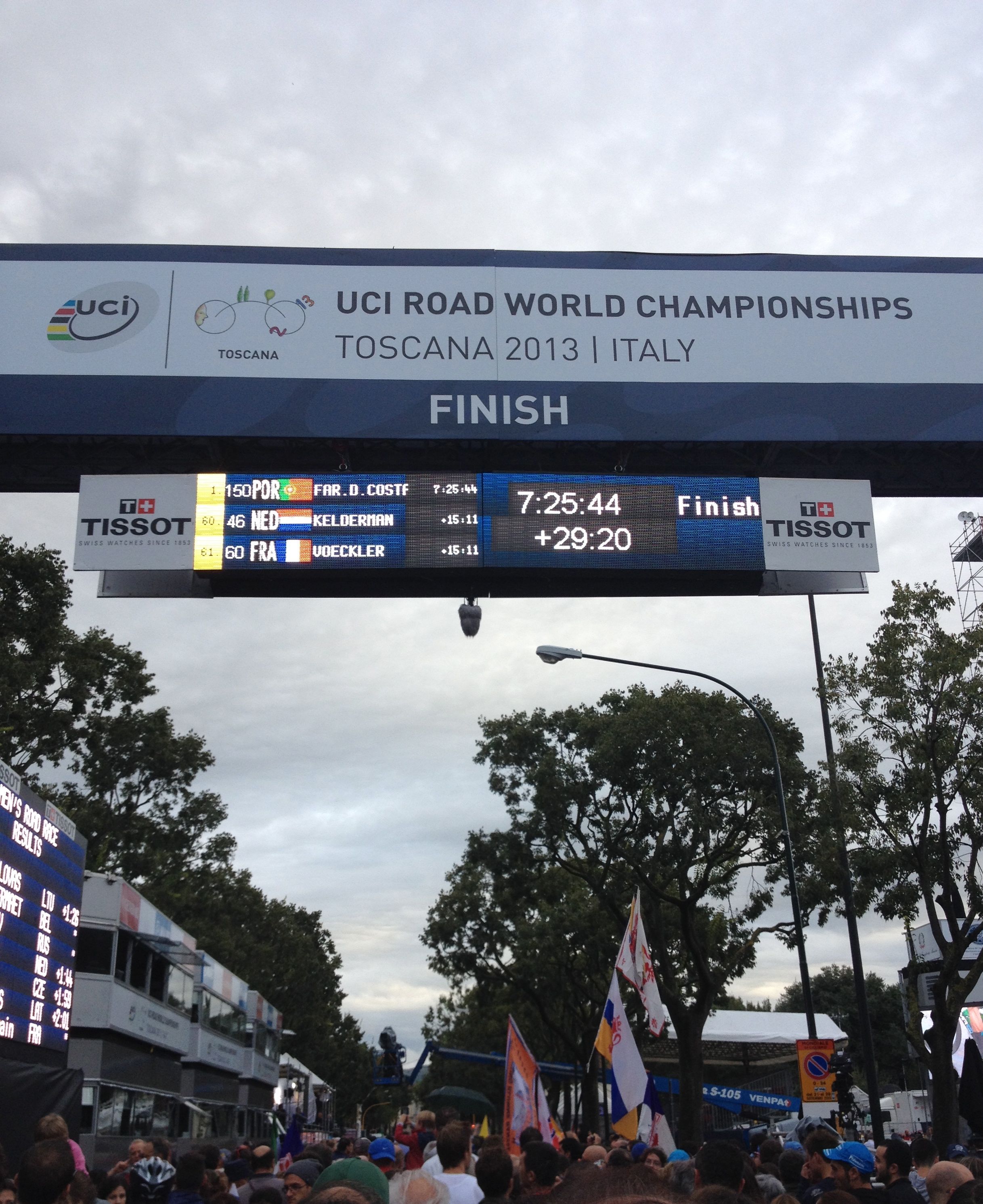
toscana 2013 finishing gate at road race

Me and Jen are in the seating area by the finish of the World Championship road race, surrounded by hundreds of bellowing Italians. It’s the final lap of the 16.6km circuit, and they are chanting one name: “VIN-CEN-ZO! VIN-CEN-ZO!” Determined Nibali, with the hopes of the host nation resting upon him, has refused to allow Joaquim Rodriguez to escape on the descent of the Fiesole. Earlier, there were long, deep groans followed by much emphatic gesturing towards the video screens when the Giro d’Italia champion slipped on the tarmac, as if the rain’s treachery had caused a deep, personal offence to each and every one of the tifosi here in Florence. “If Nibali wins,” Jen says, stifling a laugh at the very un-British outpouring of emotion, “we’re going to have to run for cover.” I get the feeling we may have to do the same even if he doesn’t…

Such passion is a contrast to four days earlier when polite applause greeted the competitors as they turned into the corner of the time trial circuit that took them north away from the bank of the Arno. Marco Pinotti got a big cheer, as did podium boys Cancellara, Wiggins and Martin, but that was about it. A bewildered Japanese lady got Jen to explain to her how a time trial works after enquiring in broken English if the event was “a European match”; a British woman who had probably wandered down the road from the Uffizi asked two men if they could move out of the way so she could take a picture (the tabards should have been a giveaway: they were press photographers, dear). It’s fair to say these were not big cycling fans.

But seated here at the incongruously named Nelson Mandela forum, it’s clear we are among those who know their Fabians from their Nairos. When Mark Cavendish slows down at the 150m sign moments before becoming one of the 146 riders to abandon, the Italian crowd instantly give the former world champ a rapturous round of applause; some even stand up for him. (A side note on Cav: I would love to know what an annoyed-looking Geraint Thomas said to the Manxman around half an hour into the race as Great Britain needlessly wasted their energy leading the peloton on the 100km-run to the finishing circuit.) One fan who gets to his feet is a testy blond fella in the front row who is not at all pleased that some of those in the crowd from the seats behind him are now politely jostling for space by the barrier. At one point he has a loud argument with one of the attendants. I’d like to tell him he should cool it: he’s in the one sheltered area of the circuit, unlike the poor wet sods on the other side of the road who have to endure diluvial conditions for hours. But I don’t speak Italian, and he’s got a Vinokourov-like pugnacity about him, so I don’t.

The haves and the have-nots: we have a roof, these poor drenched souls do not.

The haves and the have-nots: we have a roof, these poor drenched souls do not.

Each time the race rushes towards us, I experience a measure of what it must have been like when the first cinema audiences saw the Lumiere brothers’ locomotive seemingly burst out of the screen. One second they are televisual images, the next they are right in front of us, like Morten Harket stepping out of his rectangular, one-dimensional prison into the real world. By the time poor Purito becomes flesh and blood for the last time, it’s clear he is about to lose. The Italians yell and cheer, but they’ve stopped banging on the barriers. There’s a sullen silence moments after Rui Costa raises his arms in victory and then everyone begins to shuffle off, except for the Italian Vinokourov. He’s staring into the distance, making a quintessentially Italian hand gesture: thumb, index finger and middle finger pinched together, tapping the side of his head. The azzuri: what were they thinking? Minutes later, as Jen and I trudge with the crowd under the finishing gate, I want to know what the tifosi are thinking too.

The bicycles of Florence

October 2, 2013

I’ll be writing something soon about what we got up to during the World Championships. In the meantime, here’s a quick post about a few of the bicycles me and Jen saw in the shops and restaurants of Florence.

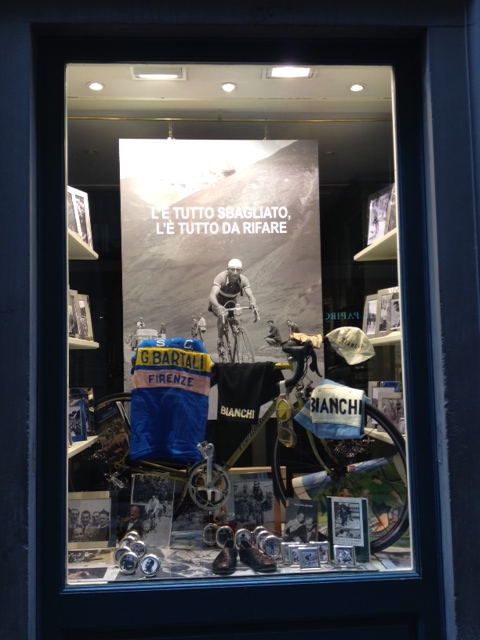
Lots of businesses put on special bike-themed displays.

shop window in florence with bike

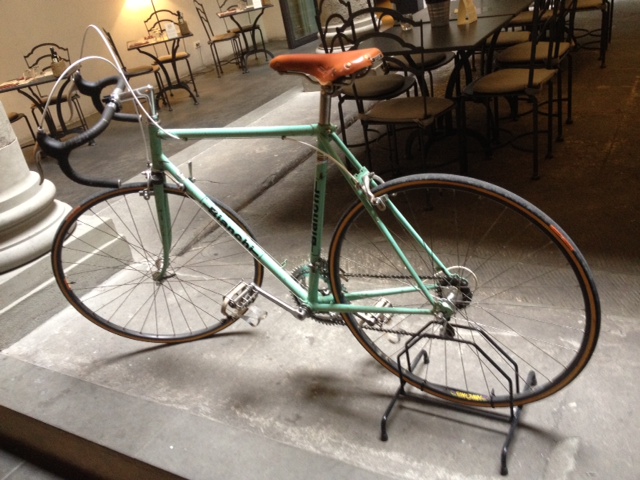
My favourite was in Obika, which is apparently a “mozzarella bar” (not sure how that works – “A pint of cheese, please barman!”) nestled amid a number of upmarket shops on the Via dé Tornabuoni. Rather than put bikes behind glass, they stuck their vintage machines in the courtyard which serves as the main dining area.

obika florence bianchi

obika florence bartali bicycle

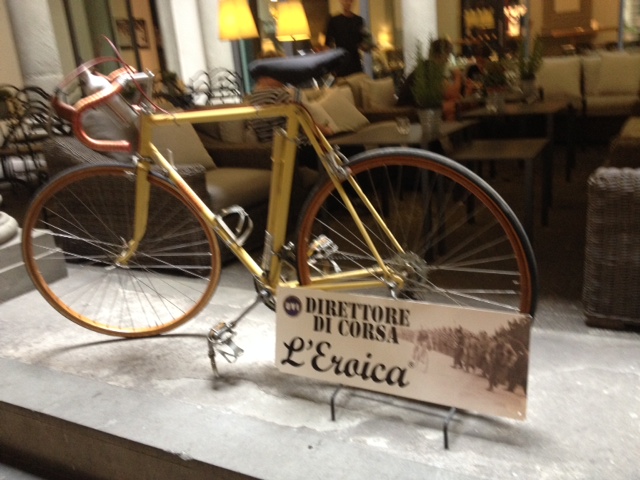
It was a bit weird going in there, gawping at their Bianchi and Bartali bicycles and leaving without actually ordering anything. My nerves got to me, which is why one of the pictures came out a bit blurry.

obika florence l'eroica

I’m sorry, reader. I’m so, so sorry.

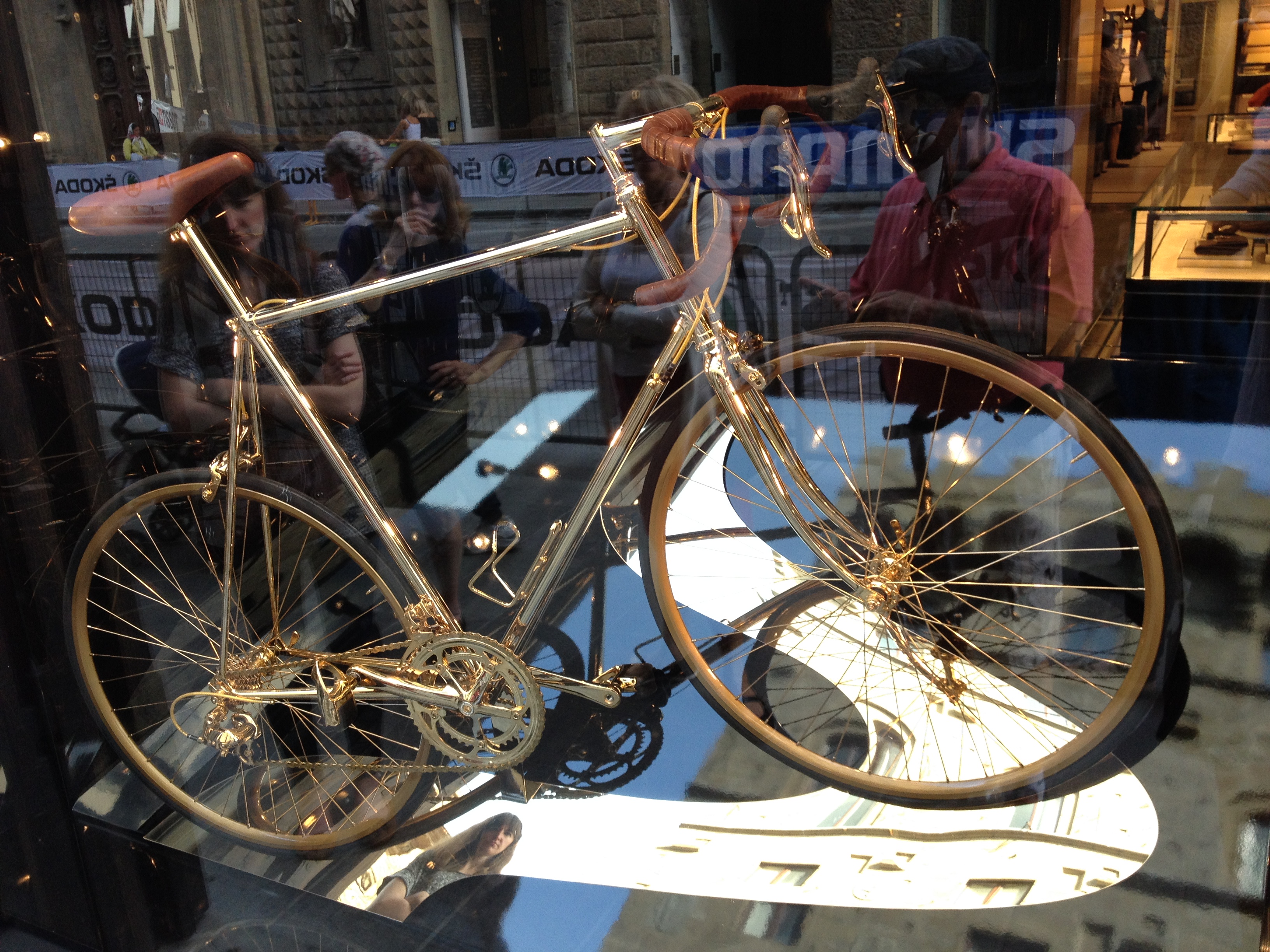
If the bikes in Obika represented one identifiable aspect of Italy – the love and respect of tradition – then the machine in the window of the Salvatore Ferragamo outlet represented the country’s opposite trait: the unashamed pride in showing off. Behold, reader, a gold bicycle in all its glory…

salvatore ferragamo gold bike

Jen wasn’t impressed. That’s her on the left, looking bored. Each to their own.

I’ve written something for the latest issue of Cycling Weekly

September 26, 2013

I wasn’t going to do any blogposts this week as me and Jen are in Florence for the World Championships. So this is just a quick note to say that my review of the Challenge Vercors is in the current edition of Cycling Weekly. I haven’t seen it yet, but apparently it’s in the sportive round-up and it looks something like this…

cycling weekly challenge vercors review

It’s got snow, a gorge and I dun rote it. What else could you possibly ask for? Buy your copy today! (Or tomorrow if you’re busy.)

So I’ve got yet another bicycle…

September 20, 2013

…and it’s only a few months since I bought my Robot Bike From The Future. But I want to make it perfectly clear I am not – repeat AM NOT – having a midlife crisis. I need this bike to get to and from work, and the last one I had broke. Here’s a picture if you don’t believe me.

crack on langster frame

It was a Langster, and I only discovered there was a crack near the dropouts on the driveside chainstay when I gave the dirty old thing a scrub. So there’s a lesson for you, kids: always clean your bicycle on a regular basis, even if it’s just a hack bike, otherwise you might not notice the frame has developed a structural fault that will cause it to snap and send you plummeting towards the tarmac, and possibly A&E.

I’ve heard great things about Specialized replacing frames that are out of warranty, but I didn’t go down that route for two reasons. Firstly, the bike was just a runaround, so I’ve left it unattended loads of times, and who knows what abuse some dozy, bored halfwit might’ve inflicted on the frame? Secondly, as much as I liked the Langster, the aluminium frame and carbon seatpost were only comfortable for short commutes; anything longer was a bit rough on the old knackers.

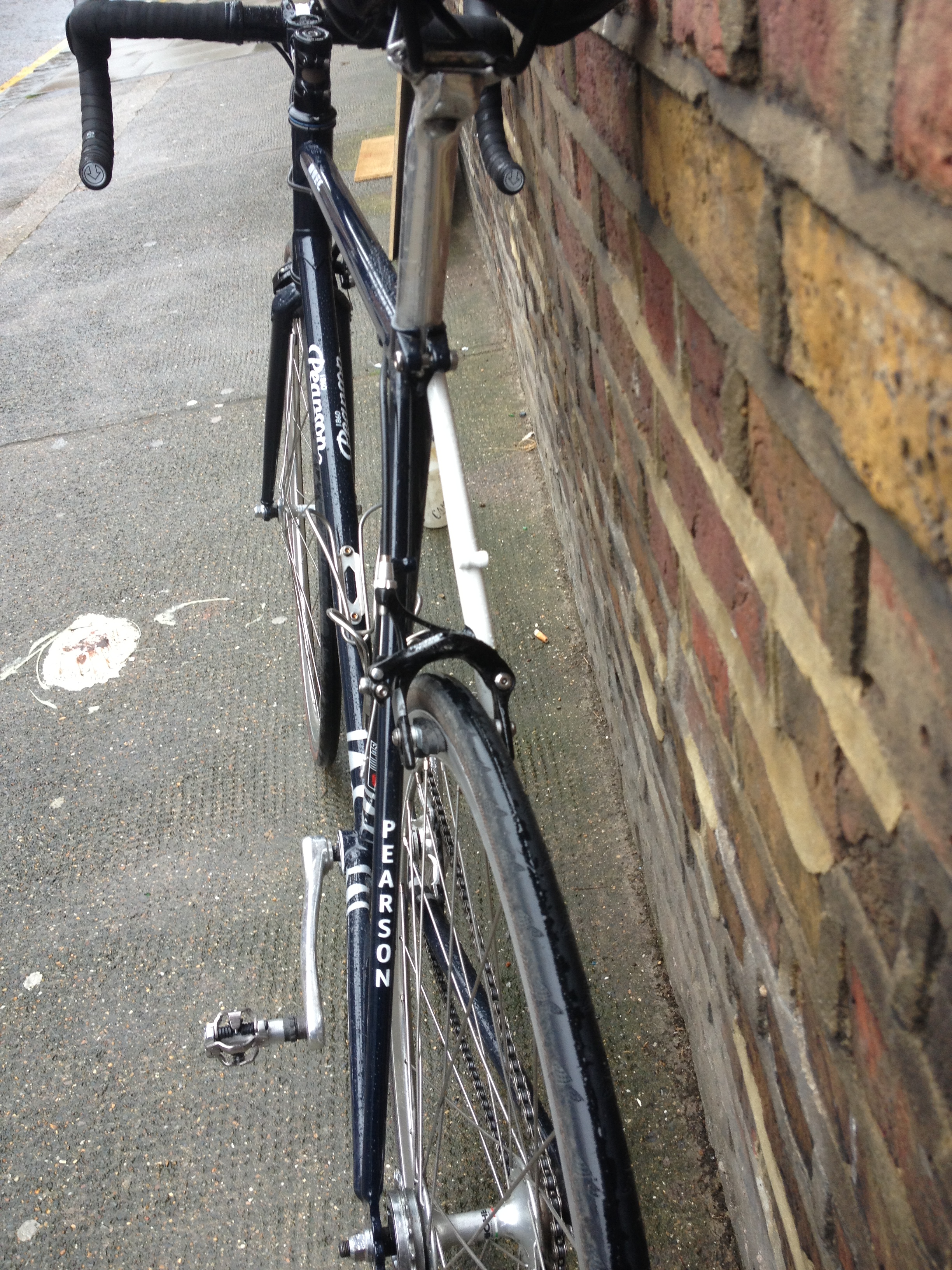
So for longevity, and because I want to do some long, flat training rides over the winter, I decided to replace the Langster with a steel frame fixie. I used one of the cycle to work schemes, opting to spend £700 (the maximum is £1,000), and voila! This is what I got…

pearson now you see me side

Like my Robot Bike From The Future, I bought it from the Pearson shop in Sheen. It’s part of their own range, and it’s called Now You See Me…

pearson now you see me front

That last ellipsis, by the way, which obviously acts as a transition to the above photo, also happens to be part of the name.

pearson now you see me name

(Also, you may have noticed that to complement the gritty, urban photoshoot which took place just off London’s famous Portobello Road, my team of stylists sprayed the bike with water to give it a rained-on effect.)

pearson now you see me back

I wanted to see how well my Now You See Me… would fulfill its dual role as a commuter and training bike, so for its first outing on Monday morning I did a round trip to Windsor before taking it into town. I am hugely pleased with the results. This bike just rolls. It dives through corners. It’s agile. And I prefer the 48×18 to the Langster’s 42×16: slowing down for a junction is more stride-and-decelerate rather than scamper-and-brake. What I like most about the bike, though, is that underneath the smooth, comfortable ride is a discernible toughness that urges you to give it a bit more welly whenever the traffic opens up to give you a clear stretch of road. The only reservation I have is the saddle: visually, I’ve nothing against the droopy tip, but I feel it might be nudging me further forward than I’m used to. I’ll need to put in a few more rides to judge it properly.

So that’s my impression after four days. And to think I may never have discovered such pleasure if that aluminium frame hadn’t cracked…

No, Evans, you can’t have my postcode

September 13, 2013

I had a small moment of personal liberation on Saturday. I was in a branch of Evans, and the bloke behind the counter asked, “Can I take your postcode, please?” They always ask this question whenever you buy something there, but like a goldfish who turns around and sees the same view he has witnessed two seconds before, I am always surprised by this weirdly personal inquiry. It’s a cheap portable lock. Why do you want to know where I live before you let me buy it, fer Chrissakes?

Invariably I blurt out the answer because, stupidly, I’m caught off-guard by the question. But not this time. “Actually,” I said, “can we not do any of that stuff?”

“Oh. OK.”

And that was that. I bought the lock without having to provide a means of identifying where I live. I experienced the same sense of relief you feel when removing a pair of tight-fitting shoes. I am free! Free, I tells ya!

Sales assistants at Evans are not the only ones to engage in this odd practice. CycleSurgery has also asked me the same question. Jen gave our postcode when she bought me a rucksack from Snow and Rock. And one of my Twitter chums informs me that Brantano, a shoe shop I had never heard of, is also in the business of postcode-gathering (his admirable response: “No, just the shoes thanks.”) But Evans was the first to ask for my postcode, and ten years later, standing in their Fulham branch, I suddenly realised I had absolutely no idea why.

Evans is the Tesco of cycling: most people shop there because it’s convenient, not because it’s a great experience. The comparison isn’t quite true in my case because, as I have previously confessed, I bloody love Britain’s biggest supermarket chain. I give Tesco a huge amount of personal information by owning a Clubcard: not only do they know where I live, they also know what products I like and how often I purchase them. But in addition to speeding up my shopping by allowing me to use their Clubcard-only barcode zappers and providing free Wi-Fi to Clubcard holders (very handy for listening to 5 Live on my phone while I’m pushing my trolley around the West Cromwell Road Enormo-Store), Tesco also sends me frighteningly specific discount vouchers for the things I like. Evans doesn’t offer this personalisation. I’ve surrendered my postcode to the green-and-gold giant for a decade, and all I’ve got in return are the same brochures and emails that everyone gets. From the customer’s point of view, telling Evans where you live is a complete waste of time.

So on Wednesday I asked Evans on Twitter why its shop assistants want customers’ postcodes. They said they needed it in the event of a refund or exchange, but the conversation went dead at their end when I pointed out that retaining the receipt performs the same function. Could it be that this isn’t the main reason?

Here’s my theory. Being a customer of a chain of bike shops is a peripatetic experience: you might pop in to one on your commute and visit another some miles away when you’re on the way back from a ride. And more than a decade ago, Evans began opening more and more branches. These days Evans isn’t just the shop you visit on your way home from a club ride or during your lunch break – it’s probably your local bike shop, too. But how did they know which areas would have a population of cyclists large enough to make an Evans LBS profitable? Perhaps it was because they already knew where their customers lived. You and I provided that information when we gave them our postcodes.

I’ve got nothing against Evans having lots of branches – they provide lots of jobs in a challenging economic climate and their existence gives cycling a greater presence on the High Street. But I’ve already got a local branch, so I won’t be giving them my postcode again.

This Assos advert makes absolutely no sense whatsoever

September 6, 2013

assos lady ad in cycle sport magazine

Assos has an ad on page seven of Cycle Sport’s October issue. It’s for their women’s range, which is called s5.ladyEllise because pre-Windows 95 filenames are definitely ‘on trend’ right now. Naturally, that woman who is in all their ads for ladies’ clothing features in this one too. She’s not semi-naked on this occasion, but she is wearing her trademark tight latex trousers and a pair of high heels. Plus a cycling jersey, of course. And she’s kneeling.

Basically, the image is a clusterfuck of contrived notions of horniness that only the Swiss cheeseball outfitters themselves could have pulled off. Bravo, monsieurs! But it’s the trio of accompanying sentences that really makes me think Switzerland’s finest bib-short manufacturer has finally disappeared up its own Assos.

WHAT IS IT? It’s the ASSOS celebration of the year 2013! Fellas, it’s no good turning up now with a pretty girl wanting to party. It’s September! The ol’ 2013 celebrations will be over sooner than you can say, “Goodbye, Lombardia”! And here was I thinking the Swiss were experts at timing. Disappointing.

ladyElisse was created and designed as a tribute to our female customers and to please the eyes of the entire ASSOS community. Can’t help thinking you’ve fallen short of achieving these goals, lads. Looking at that image, I can see that the Assos lady wants to go out (latex pants), have sex (kneeling, head dipped at optimum ‘come-and-get-it’ angle) and ride a bike (cycling jersey) all at the same time. No woman wants to specifically do these three activities simultaneously, and no man finds that level of multitasking sexy (onerous and tiring, yes; sexy, no). Also, in the midst of your fevered imaginings, you have managed to get the name of your own range wrong: “Ellisse” has a double ‘l’, not one.

Number 13 has a special place in the ASSOS world: it’s level 13, symbolizing the manga.Yio state of mind, the perfect ride, ASSOS nirvana. Right, bear with me here, because I think I can provide some sort of translation. The “13” obviously comes from 2013. “Manga.yio” is the Assos online store. (The URL is mangayio.com, which is somewhat appropriate as their male model looks like a homoerotic mandroid.) “Manga-yio” is also the name of a half-baked philosophy which is supposed to have 13 levels of enlightenment but which appears to have only seven: level 1 is “party party” and level 2 is “sex”. Which is what it’s all about, isn’t it? Partying and sex. Sex and party, partying. There’s not much to do in Switzerland, so the Assos top brass had a brainstorming weekender that degenerated into a sex party, and in the post-orgasmic brain fug they managed to cobble together some sort of free-forming philosophy and an ad campaign to go with it. Yep, that’s it.

Well, it’s my theory anyway. And I defy you to come up with a better one.

It will cost you €100 to stand on one of the best spots of the World Championships’ course

September 4, 2013

Jen and I have been planning our trip to the World Championships, which takes place at the end of the month. We figured it would probably be a right old hassle to get from our hotel in Florence to the Fiesole, the longest of two climbs on the closing circuit, so we decided to fork out €100 each for seats by the finish line. And I’m pleased that we did, because we’re going to be in row ‘A’! Woo-hoo! That’ll be a prime perving spot for Jen, especially if David Millar turns up.

As far as I know, getting into the grandstand at the finish of the Worlds usually involves opening your wallet – there was certainly a charge last year in Valkenburg, and I’m pretty sure that was also the case when Cipollini triumphed at Zolder in 2002, although I was on a press trip that year so I was too busy scoffing vol-au-vents in the VIP area to investigate. What has surprised me this time ’round is that the Italians are also charging €100 to watch the race on the Via Salviati, the finishing circuit’s short, punchy climb… and you don’t even get to park your bum on a plastic seat.

So, basically, that’s €100 to experience what most of us expect to do for free: stand by the side of a public road and watch a bike race. That sounds a bit rubbish, doesn’t it?

To be fair, the climb is only 600m long and it appears to be quite narrow, judging by footage three enthusiastic Americans have made of the circuit…

uci worlds circuit 2013 via salviati

…so ticketing is probably an effective way of limiting access to what appears to be a restricted space. And the price gives you three days’ access, which covers the men’s, women’s and juniors’ road races.

But even so, it’s £84. Access to Box Hill, the centrepiece of the 2012 Olympic road race, only cost 15 quid. Why so blimmin’ high, UCI?

Cyclists in comic form

August 30, 2013

Here are two very different comic strips I’ve enjoyed recently, both of them featuring cycling. The first is how many of us would probably like to see ourselves – a glorious phalanx of wheels and whimsy enveloping an entire city – and the other is a chuckle at the grim reality.

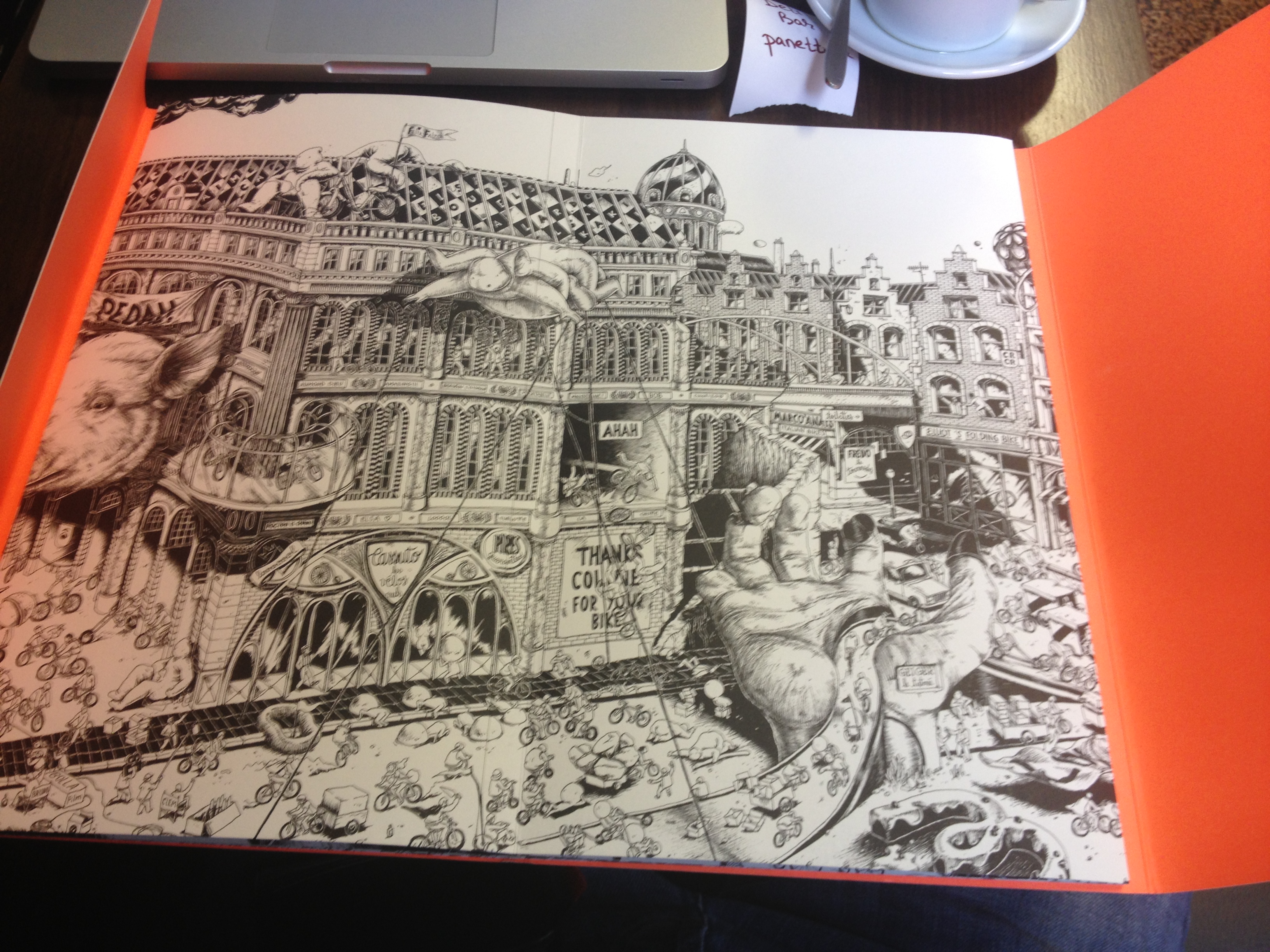
I’ve been meaning to write about Bicycle by Ugo Gattoni since Jen gave it to me for my birthday a couple of months ago. Inspired by the 2012 Olympics, this dialogue-free strip is a lurching cityscape featuring a bike race, drawn in a rambunctious, surreal and heavily-detailed style. I guess you might call it Richard Scarry meets Hieronymus Bosch – or you might not if, unlike me, you have a thorough working knowledge of the visual arts.

It comes in a folder and opens out into a long, double-sided poster.

bicycle gattoni open

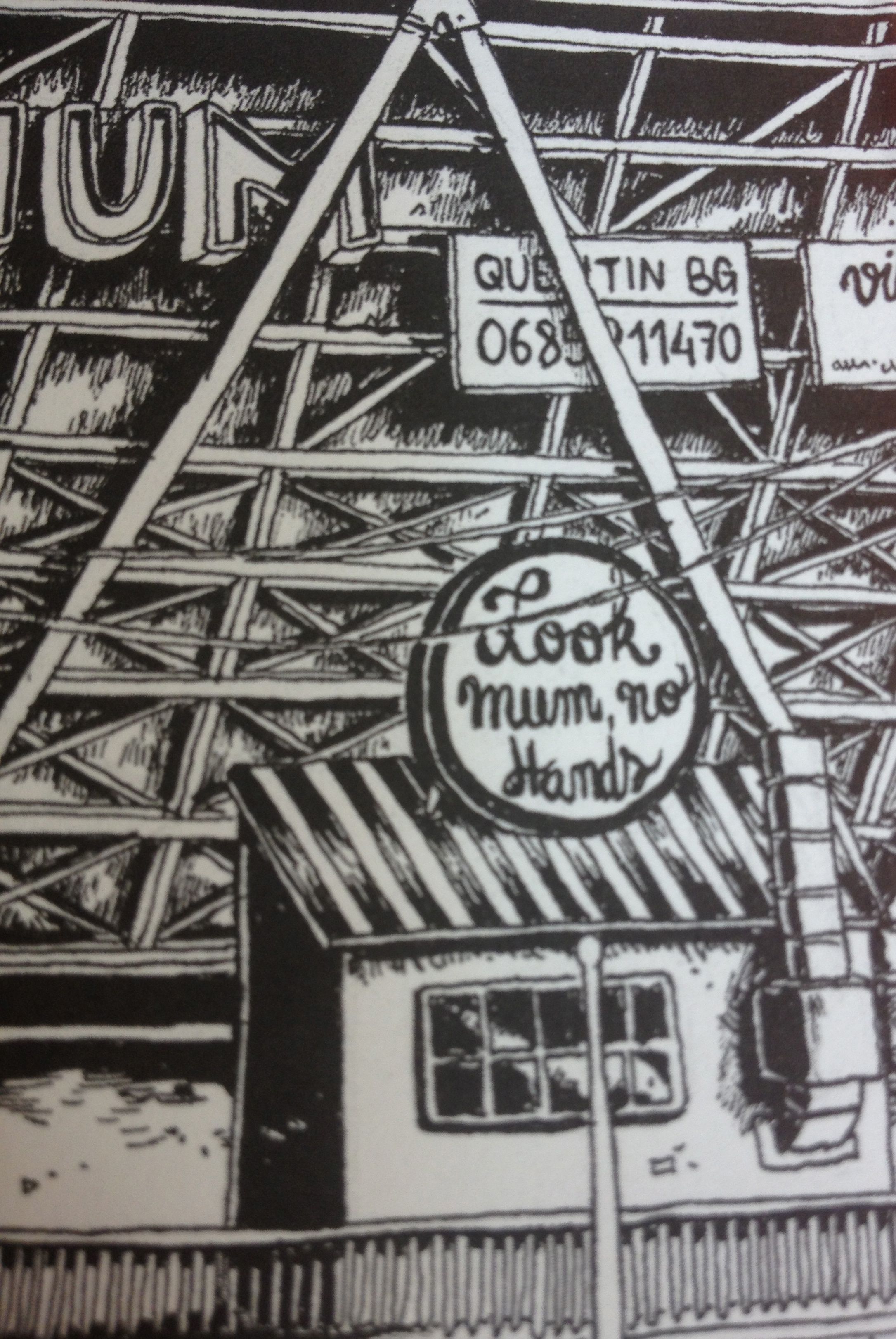
The sprawling journey is anchored around real landmarks – Big Ben, the London Eye, Regent Street and so on – while the smaller places appear to be made up (Gattoni, who is a Frenchman, has populated his version of Britain’s capital with fictional French shops). I can spot only two references that are the exception to this rule: Nobrow, the publisher of Bicycle, and Look Mum No Hands!, which has an advertisement in a version of the cafe’s distinctive cursive script stuck on the side of the Olympic Stadium.

bicycle gattoni look mum

That gave me a kick. It’s like when Pulp did a song about Bar Italia – you have an indication that a place has left some sort of a mark on the cultural consciousness when it’s referenced in a creative work. Or maybe the Look Mum fellas simply bunged Ugo a few Euros for a plug. Obviously, I prefer the former explanation.

The second strip I’ve come across is two pages in the latest issue of the peerless Viz. In Cockney Wanker, the eponymous cabbie flies into a panic after he runs over a female cyclist. “Is she orwight?” worried Wanker asks his mate Barstard…

viz cockney wanker crash

…before it’s revealed that the “she” he’s concerned about is his beloved black cab.

viz cockney wanker cab

This isn’t really satire or any serious attempt to make a social point. The joy of Viz is watching how the narratives push the already ridiculous characters into ever-more ludicrous extremes. In this case, Wanker gets the injured cyclist to pay for the damage to his vehicle by taking her card out of her handbag and running it through his PDQ.

viz cockney wanker pdq

Sorted.