Can we sign two petitions? Yes we can

November 9, 2012

“The bucks stop somewhere around here, Hillary!” I imagine this is what Obama might be saying if this was actually Richmond Park.

As a British person, you may have felt left out as you watched our American chums preparing to choose their president. And now they’ve made the right choice, perhaps you’re wondering how, in your own small British way, you too can make a difference. Well, fear not! For I have found a couple of petitions with which you can express your idealism, good nature and sound judgment.

The first petition aims to increase cycling access in Richmond Park by excluding motor vehicles from the seven-mile loop on Sundays. The giddy dream is that the proposal will be debated in parliament if it gets enough signatures.

At first, I thought the concept isn’t a bad idea. Cyclists who don’t yet feel confident riding among cars would get their own mini-Sky Ride every weekend. Then I posted a link to the petition on the London Dynamo forum, and now I think it’s a great idea. Because, perversely, it seems my cycling club – one of the largest in the country – is not keen on this particular plan to promote bike riding. And if there is one defining hallmark of a great idea it is the mood of fearfulness with which it is greeted.

You can’t read the thread I started unless you’re a member, so I will try give a fair précis of the objections and provide my counter-arguments. The main fear is that with lots of beginners and children pootling along at 10mph, more serious cyclists such as myself wouldn’t be able to use the park for training rides on Sundays. Well, I’m fine with that. Dynamo’s group ride in the park is on Saturdays; everyone heads for the hills of Surrey on Sunday. Under this proposal, less experienced riders would get to enjoy the park for one day a week, ’Mos and other club cyclists would get the other six, and maybe at some point a few of those beginners would gain the confidence to ride with us. We all win!

Another objection is that it fixes a non-existent problem: you can still use the park early in the morning when there is almost no traffic. I would suggest the almost total absence of pootlers at that time of the morning shows this is a lousy option that has, in effect, already been rejected. If I had kids, I wouldn’t relish waking the family up at the crack of dawn and getting to the park to ride for a measly hour or less before the cars showed up. The other alternative is sticking to cycling on the straight strip of car-free tarmac bisecting the loop, which is an excellent plan if you want to be bored out of your mind. You’ll never get more people cycling if you make the activity seem unappealing.

Some Dynamo members appear to be thinking of other people’s concerns. What about the residents surrounding the park? Surely they won’t like golfers parking on their doorstep to use the park’s course, and they’ll be miffed at the increase in traffic on the roads in their neighbourhood. Also, if fewer people visit the park, then there will be an economic impact on the cafes within its grounds. But then there is no guarantee any of these eventualities will occur. Sunday golfers may have a round on Saturday instead. Roads surrounding the park do not become insurmountably clogged when it is closed for deer culling. The custom of hungry cyclists in cafes could replace that of motorists.

There was one alternative suggestion to car-free Sundays: a congestion charge, levied in the park throughout the week. I suppose this ambitious plan could reduce the traffic, although it can’t weed out the worst drivers, which is what really puts people off riding. So it’s only a partial solution.

Basically, it comes down to this: I would like less confident riders to experience of the same simple pleasures I have enjoyed in the park over the years – things like the big, long descent or the nonplussed deer watching you on the small climb to Richmond Gate. So if you think this a reasonable and commendable aim, then please add your name to the list.

The second petition I signed aims to reinstate Danny Baker’s weekday afternoon radio show on BBC London 94.9. You’ve probably heard what happened to the Candyman after coverage of his magnificently funny and defiant two-hour swansong last Thursday made just about every news outlet you care to mention, including the front page of The Times.
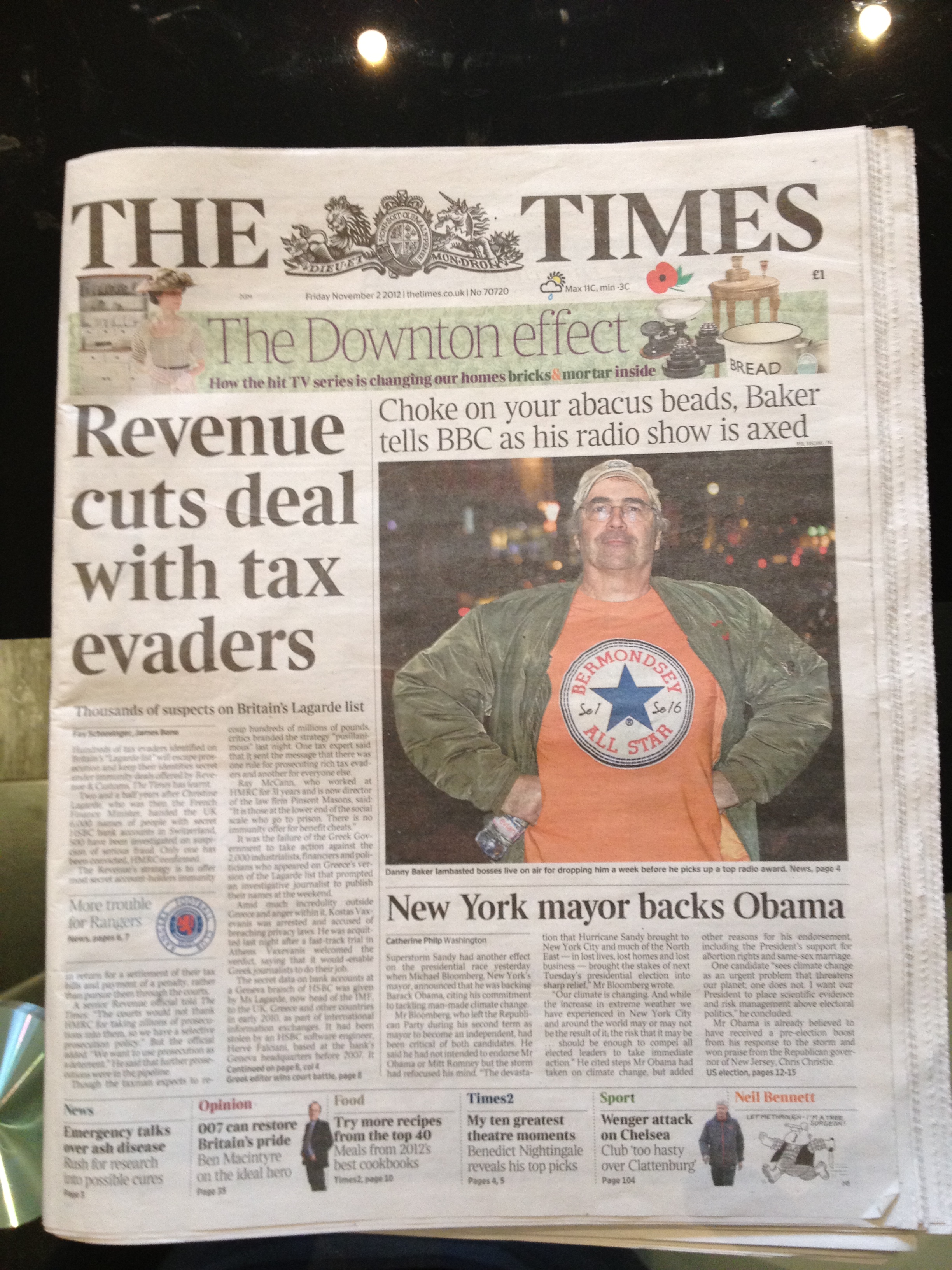
And yes, regular dwellers of this blog will have already noticed me gabbing on and on about how much pleasure Danny’s show has provided. Nestled amid the phone-in topics and chats with his co-hosts Baylen, Amy and the inimitable David Kuo was a central idea: that the kinks, quirks and fleeting moments of oddness in popular culture and people’s everyday existence are what gives these things life. So if you value originality and good humour – which, of course, you must surely do – then sign now. If you do, I promise to stop gibbering on about how much I love Danny Baker. You can’t say fairer than that.


Cycling confessions

November 2, 2012

What every cyclist needs: a confession booth

Currently, the mood in cycling is one of revelation: I took drugs, I was on the books of a notorious Spanish doctor, I couldn’t help noticing Lance thought Bobby Julich was a bit dull. That sort of thing. But it’s not just the pros who have had something to hide. I, too, have harboured dreadful secrets. And now, pausing only to offer sincere apologies to those I may have hurt by not speaking out sooner, I shall now unburden myself of the guilt that has wracked my conscience. In return, I ask you to find the compassion in your hearts to forgive me for breaking some of cycling’s strictest edicts…

I do not drink coffee. There – I’ve said it. Drinking coffee makes me more tired by the end of the day, and I don’t miss the hit or the taste. More importantly, I came to realise why coffee lovers talk about which brands they prefer without usually discussing the differences: it’s because all types of bean juice taste roughly the same. Seriously, they do. Starbucks and your favourite independent coffee house both leave, quite literally, a bitter taste in your mouth. It’s just a slightly different bitterness. So have a tea instead, guys! Any tea! Black tea, green tea, fruit teas – there’s a lot more variety. And greater variety means more opportunities to indulge in cyclists’ favourite pastime: arbitrary snobbery. You can’t lose!

I have never looked at a carbon Colnago with envy. They look fine. Perfectly fine. Not beautiful, stunning, amazing, awesome, just… OK. Like a nice fitted kitchen or a sensible hat. To me, they appear to be just another assemblage of carbon tubes, but without the futuristic wowness of, say, a Felt, or the old-school romanticism of a hand-built steel frame. They’re sit somewhere in between. With an Italian name. Total whatevvs.

I don’t want to ride the Etape. One of my favourite pieces of cycling-related prose is Bill Strickland’s pithy, insightful and funny article on the Etape du Tour, which appeared in Rouleur’s 2008 photo annual. Bill evokes the event as a kind of living trance, where the landscape and your fellow riders recede from your immediate perception, thereby provoking a reckoning with yourself. And I can relate to that; I’m just pretty sure I don’t want or need that experience from a sportive. I think sportives should be pleasant jaunts around unfamiliar locales, and the Etape always looks far too over-populated and bloody serious to provide that sort of ride. Also, for me, riding a stage from the actual Tour de France without the speed or ability of a pro would be like running around Wembley Stadium while pretending to kick an invisible football. For these reasons, I am never going to ride the Etape.

I’m not that bothered either way about disc brakes or electronic shifting. I think I’m supposed to feel strongly one way or the other, aren’t I? I just can’t muster the effort, fellas. I’m sorry. Look, if the industry wants it to happen, it will happen. One set of aesthetic values will shift to accommodate another. And if you’re a diehard fan of rim braking or analogue gears, then you’ll probably be able to stick with them. Bicycles will still be able to start and stop. Them wheels will keep on turning. Let’s all have a group hug and try not to fight about it, OK?


What’s the best way to listen to Danny Baker while riding a bicycle?

October 24, 2012

I’ve mentioned before that one of the central pleasures in my life is listening to Danny Baker on BBC London while I ride my bicycle into town. To do this, I used to use the TuneIn app for the iPhone, but it has a rude habit of cutting Danny off mid-anecdote, restarting a moment later at the same point it lost the signal, then skipping a few seconds to catch up. By which point Danny has gone to a Fountains of Wayne record, and I’ve missed the funniest bit of the story. Curse you, capricious app!

For this reason, I now listen to the world’s greatest radio show on an FM radio accessory which plugs into the old version of the iPod. But I’m no analogue snob, and it’s irksome having to carry a phone as well as an iPod, so this week I gave the new BBC iPlayer Radio app a whirl.

Is it any better than TuneIn? Well, after dialing up BBC London 94.9 using the whizzy little semicircular station selector, it soon became clear that it isn’t. On my seven-mile journey, the signal conked out three times – and unlike TuneIn, which attempts to reconnect automatically, I had to stop riding and restart it. Another advantage of TuneIn is that you can listen to practically any station in the world, not just the BBC’s output. So if you can put up with your favourite show going silent mid-broadcast, then choose TuneIn over iPlayer radio.

Yesterday was a decisive moment for a number of familiar technologies: Ceefax displayed its final pixels, and Apple sounded the death knell for CDs and DVDs by announcing that the new super-slim iMac won’t have an optical drive (although you can buy an external device if, in the slightly condescending words of Apple’s marketing chief, you are “stuck in the past”). FM, meanwhile, the old iron horse of audio broadcast media, has kept on going – even if it is, like an OAP, a little fuzzy at times. Perhaps 4G will be so fast and reliable that I’ll be able to chuck out my little iPod radio attachment, but at the moment it seems clear that radio apps don’t work as well as they should on 3G. So I’m puzzled why the BBC released theirs now. In the meantime, it’s FM for the Candyman.


A couple of intriguing magazines

October 19, 2012

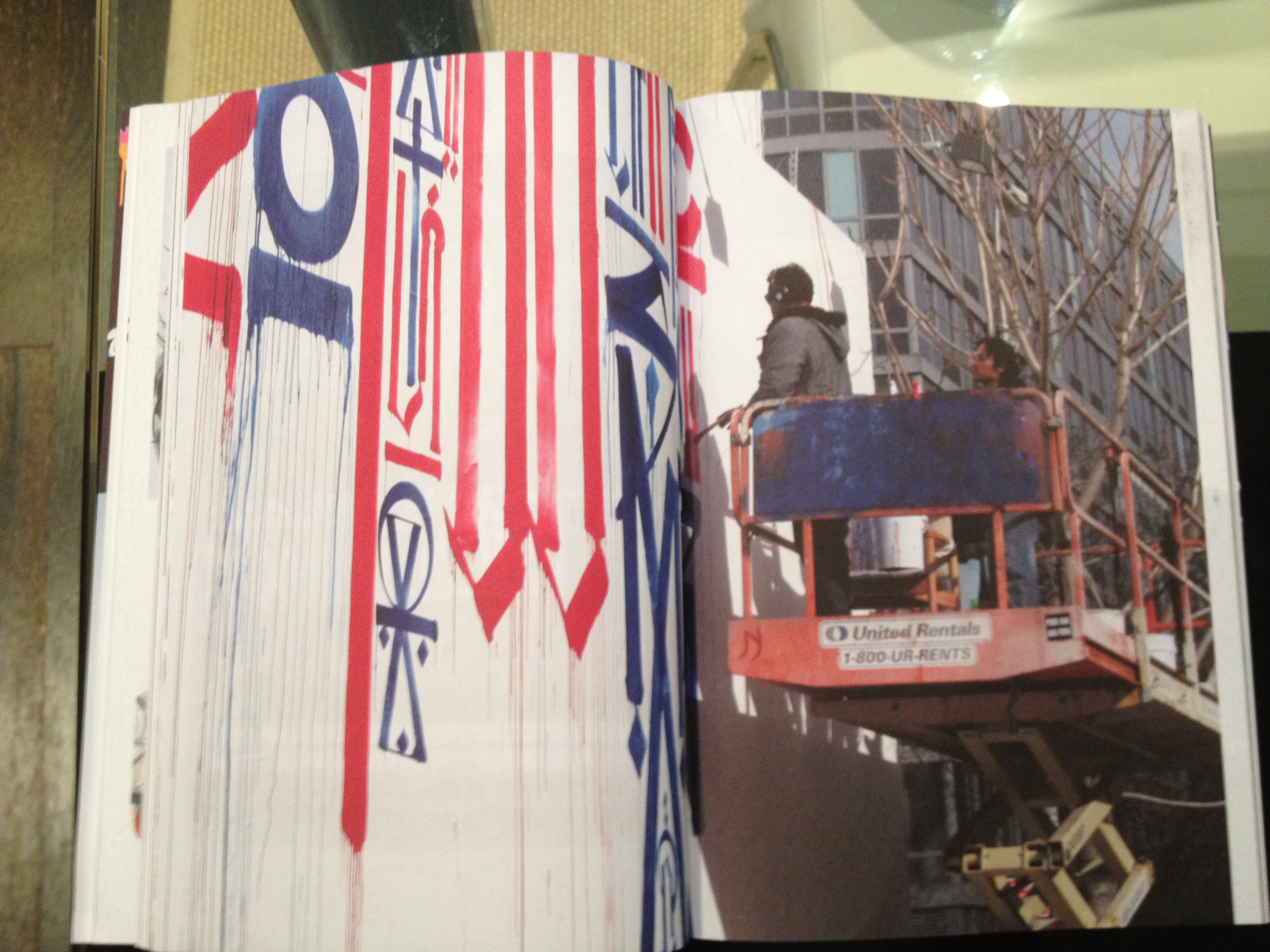
Can you recall, as a child, plunging into a picture book and immersing yourself in a strange new land? I got a similar kick this week after issue 20 of VNA magazine popped through our letterbox as part of Jen’s mailout from Stack, the ever-dependable independent magazine subscription service. VNA (which stands for Very Nearly Almost) is about street art, a distant, magical and sometimes nightmarish world of which I know nothing, save for a brief visit to the paint-strewn streets of Brussels a few weeks ago which you may or may not remember me gabbing on about.

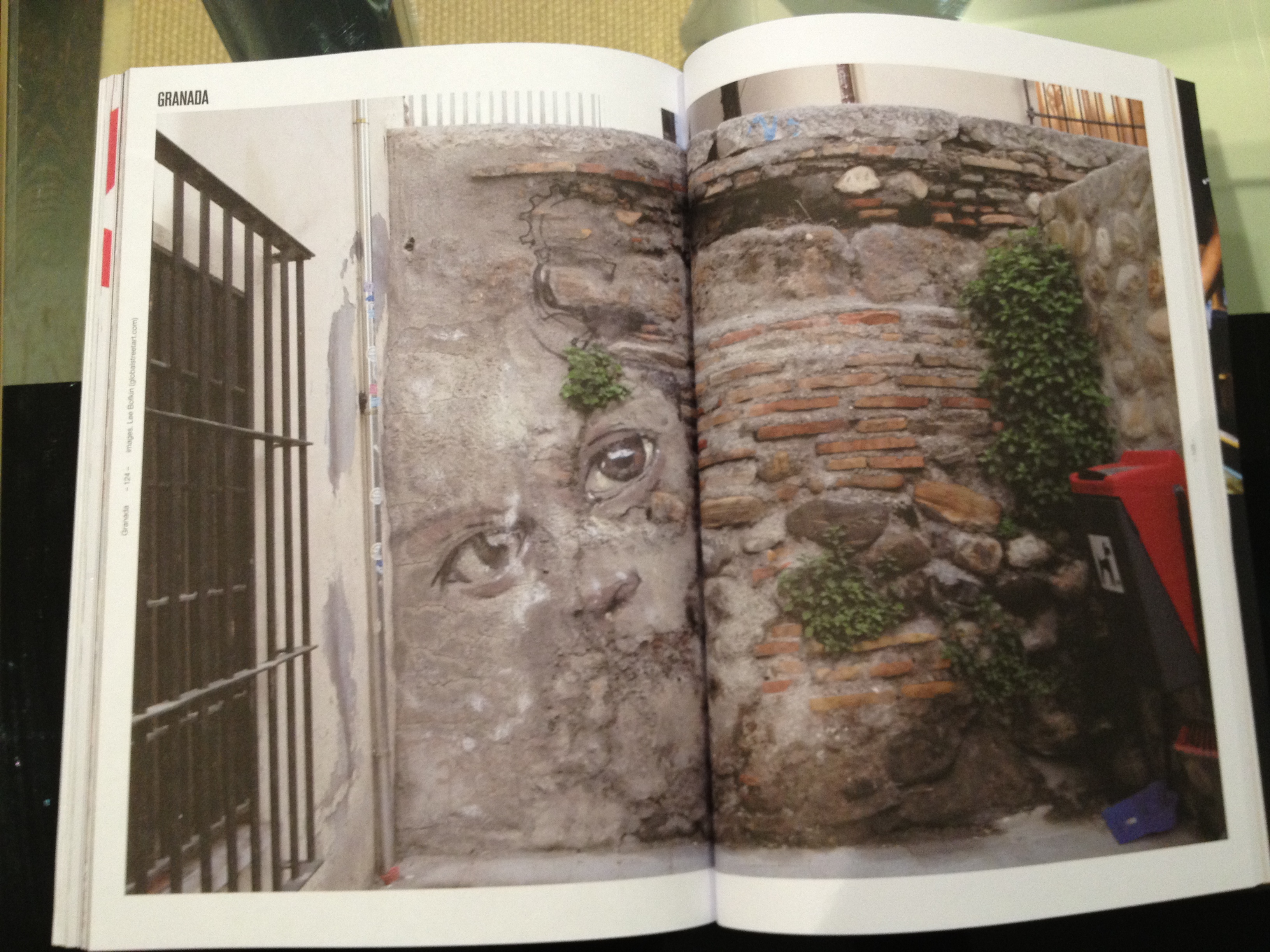
What I like about VNA is that it is packed with lots of interesting, amazing stuff I had never seen before – which is what we all want from a magazine, right? – and the writing is engaging and focused, placing a varied collection of artists in their own particular artistic context. My favourites were Guy McKinley’s ornate, fantasy-inspired portraits and the imposing symbols of cover star Retna, who Jen informs me is apparently quite famous. There is also a painting of a child’s face seemingly embedded in a wall in Granada that caught my eye.

VNA is in a nice compact format and it only costs six quid, which isn’t bad for an indie mag. So why not give it a go? I’m sure you’ll find something you’ll like in it, and I can’t say that about many magazines.

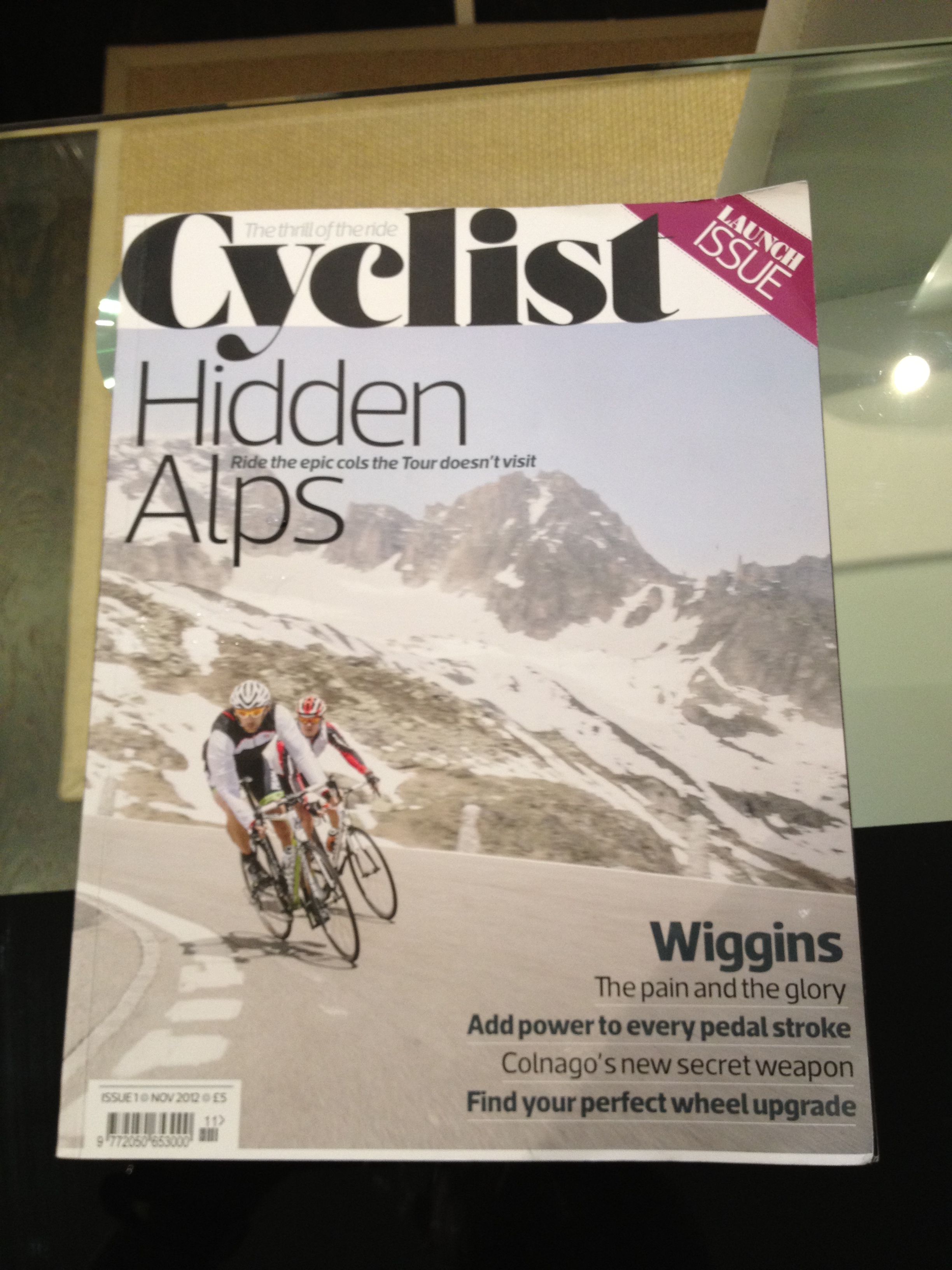
Another new visitor to our magazine rack is a new publication simply entitled Cyclist.

Essentially, it’s adapted the Cycling Plus format of clear, informed product reviews, added a dash of pro peloton features and delivered it in a stylish, upmarket package with a not unreasonable £5 cover price. Some of the photography and their feature on the Colnago factory are reminiscent of Rouleur (interestingly, Rouleur’s publisher used to be a suit at Dennis, which publishes Cyclist, and both magazines are advertising in each other’s pages).

I think what may set Cyclist apart from other cycling mags is that it feels more current – issue one included a neat spread on the trend for all things fluoro, a feature on electronic shifting and a look at disc brakes as part of the Colnago piece. More importantly, it is packed with facts, which makes it sound a bit dull, but I think clearly presented information is what cyclists value above all else in a magazine.

The writing may need to be warmer, and it will be interesting to see how it develops its own voice. The only thing I really didn’t like was a column by Velominati rule bore Frank Strack, but that’s a long post for another day. Overall, I think Cyclist has made a solid start, and you shouldn’t ask for anything more from a new magazine. Issue two is out this week. I bought my copy at Pearson Performance, so maybe you’ll find it at your local bike shop too.


Lance falling

October 11, 2012

Nine years ago, Jen and I went to a bar on the Haymarket, had a few drinks, met some fellow cycling fans and watched Lance Armstrong fall off his bike. The famous tumble on the road to Luz Ardiden caused by a spectator’s musette caught in Armstrong’s handlebars had taken place earlier that day, although we hadn’t turned up with the intention of watching the yellow jersey and Iban Mayo have a whoops-a-daisy. We didn’t even know it had happened – both of us had been at work, Twitter hadn’t been invented yet, and mainstream news outlets didn’t give a toss. The reason why we went to watch a big screen at a West End watering hole had something to do with engaging in what was a unique experience for us in 2003: being in a room with other bicyclepeople who liked watching bicycle races. Because we knew very few people who did.

The shindig at the Sports Café was organised by Phil Cavell and Julian Wall of Bikepark in Covent Garden, which later evolved into Cyclefit, the business which is more or less responsible for bicycle fitting becoming a standard part of the bike-buying process. Paul Callinan, who had chatted to me at the Hillingdon circuit when I tentatively started racing, was among those attending. A few months later, after Bikepark stepped down from organising its two popular weekend group rides, Paul and a couple of friends would seize the momentum by reviving a name that Jules had coined in the mid-nineties for the early incarnation of his shop’s team – and so it came to pass that the all-new London Dynamo, which started life as a discussion in Paul’s kitchen, became a phenomenon that swiftly (and inadvertently) grew to be bigger than every long-established club in the south-east. Also propping up the bar on that July evening was Nick Peacock (he later sold me his Merlin frame after he became Dynamo’s second club captain, although I think we didn’t get round to speaking to each other that night) and triathlete-turned-demon-time-trialist Martin Williamson, one of many kindly ’Mos who gave me a lift to races during my first season as a non-car-owning fourth cat. But that night we were all more or less strangers to each other.

So there we all were, the many and varied chums of Bikepark, watching Armstrong fall off, get back up, wallop his groin into his top tube as he came out of his pedal and then solo away to victory. Chapeau! Except no one exclaimed “Chapeau!” or “Hat!” because it hadn’t occurred to any of us yet that pretension or irony had a place in cycling. The mood was more of muted amazement rather than the whooping, roaring enthusiasm you now get at Look Mum No Hands! during an eventful moment of a big race. This was fascination before it evolved into fandom. And we all know the aspects of Armstrong’s story that fascinated us: beating cancer and then beating everyone, a singular character with a single ball. Personally, I loved watching his movements on the bike, swaggering when he was out of the saddle, and the robotic, propulsive, high cadence when he was seated – a contained, measured ferocity. Yet most of the conversations that night weren’t about Armstrong or pro cycling, but about our own, more modest, adventures: where we had been riding, where we planned to ride or race, each of us glimpsing the others’ characters and experience (invariably much greater than mine) by learning about their cycling history.

And when Dynamo began, I still didn’t know who my riding chums actually were. They each had a name, a bike and stories about their riding, all of which helped to identify the less vocal members who dwelt beneath the ubiquitous mask of helmet and sunglasses, but the life they lived beyond our weekly 50-mile training loop across the Surrey Hills was a distant vista. Before setting out one Sunday, Paul muttered wearily to me about having practically no sleep because he had been on call all night. Ah-ha, I thought – a doctor! It took a while for me to discover that he actually worked in IT for a bank, and being on call involved piping zeroes and ones to the Far East in the early hours of the morning. But at least I knew his name – I can still recall the delight at discovering “Nicholas Peacock” on the finishing list of Dynamo’s inaugural Beginners’ Series race, because the surname was part of a long-standing in-joke between myself and Jen. (And as it’s a slightly bizarre gag which isn’t aimed at Nick, it’s probably best Jen and I keep it to ourselves…)

Dynamos were Dynanonymous to each other – but the one name everyone knew, whether they had a rich history of riding or had just started out, was Lance Armstrong. There was a unique combination of factors that led to Dynamo confounding a British Cycling official’s prediction to Paul that we would probably attract a total of around two dozen members: as the only club to have a regular ride in the cycling mecca of Richmond Park, we were conspicuous; we welcomed all-comers; we were, and still are, a friendly bunch; and, in a major departure from the aesthetic of the time, our jersey didn’t comprise a clumsy mélange of fonts and colours or resemble something an estate agent might hammer onto a stick. But I think the main reason why Dynamo grew so rapidly was due to a pool of new, unaffiliated riders who had recently taken up the sport after an English-speaking athlete had caught their attention by repeatedly winning the Tour de France. Armstrong was the key that unlocked the entrance to a previously clandestine world – and if he could get on a bike after what he had been through, then why couldn’t you?

So the blue train of the US Postal Service team unwittingly begat a blue, black and orange locomotive – although it is there that the parallels, like two diesels thundering towards each other, must screech to a halt. I can dimly remember a line in Procycling magazine claiming that Armstrong-related catchphrases such as “No chain! No chain!” and “How d’you like them apples?” had become de rigueur on club runs – and oh, how I cringed, because from my experience of Dynamo, amateur cycling didn’t take hero worship or wish fulfillment to those extremes. Talking about Armstrong, or pro cycling generally, was an excuse for men (sadly, there were only men in those days) to indulge in the necessary human act of gossiping, sharing our awe about feats that had amazed us, trading information, often as a means of trying to work out who would do what the next time around. Would Jan Ullrich ever win another Tour? Could winning the Dauphiné prove to be a poison chalice for the Texan? And, inevitably, along came the only question that never went away: do you think Lance is clean?

Fast forward a few years, and half a dozen ’Mos are sitting on one of the benches outside the Roehampton Gate café in Richmond Park after the Parkride. I’m one of them; two others are also long-standing members (although they’re not the Dynamos I mentioned earlier). Armstrong has decided not to contest the US Anti-Doping Agency’s case against him, and the consensus around the table is that, as a result, no one will truly know if the man stripped of his seven Tour wins ever cheated. Most think the case should never have been pursued because it happened a long time ago, everyone was at it, and USADA doesn’t have any authority in the matter anyway. One Dynamo calls USADA boss Travis Tygart “Travis Dickface”.

Well, Mr Dickface does have the authority, and USADA’s 200-page report released yesterday, featuring damning testimony from every American Tour rider who rode for USPS and Discovery, may convince the doubting Dynamos I listened to that morning. Perhaps I should have pointed them in the direction of the truth: there were some professional cyclists who asked Tygart to sit in as an observer when they were questioned as part of the original federal investigation into USPS – so USADA had to pursue the allegations, because this is what they are funded to do. Anything less would have been corrupt.

But I didn’t say anything. And I’m pleased I kept my trap shut, because the opinions I heard that morning were not those of diehard fans desperately clutching at straws; they were an expression of disconnection from a complicated story that has been twisting and turning for years. True, a few of my cycling chums have followed the slow, inexorable exposure of the EPO years, but they tend to be the minority whose interest in pro cycling began prior to Armstrong’s appearance. I get the impression that most of the cyclists I know have simply not followed the diffuse trail of whispers and nose-tapping which has been played out mostly on fan sites and forums. They’re not angry or disappointed about Armstrong’s fall from grace, because they’ve not been exposed to much of those areas of the internet where anger and disappointment reigns. Threads on our own forum these days about tyre choice, groupsets or any other quotidian aspect of bike riding dwarf those about Armstrong, while the full-throated, joyful cheers we’ve given to Wiggins, Cavendish and other home-grown heroes are more passionate, more engaged than the interest anyone had showed for the Texan. One reason for that enthusiasm is that the likes of Wiggo and Cav are British, and their Olympic exploits were performed on roads we’ve all ridden. Another reason, of course, is that the performances have become more believable.

So let’s remember the Tour de France 1999-2005 in this way: lots of people took loads of drugs and did some amazing things, and we all had a good time witnessing them. But like the big screen looming over our conversations that night at the Sports Café, Armstrong’s adventures have proved to be just the background noise to our own experiences on bicycles. It’s not about the bike rider who brought us together – if, indeed, it ever was.


Vent frustration

October 3, 2012

Helmets have it easy. As a helmet, all you’re doing most of the time is sitting on your owner’s noggin, trying (and failing, usually) to not make them look like… well, a total helmet. Just maintain a purposeful and protective appearance, while the wearer resembles a bulb-headed alien, and you’re fulfilling the everyday functions of being a cyclist’s crash hat. And to their credit, the helmets I have owned carried out this role with a stoical pride. Until, after many long rides, one cracked. Quite literally.

The fissure on my 15-month-old Specialized Prevail was not the result of a crash or any abuse. I have no idea how it got there. I simply took the helmet off last week, and there it was: a crack right at the front, underneath the vent.

Sigma, who sold the helmet to Jen when she bought it for me as a birthday present, enquired about getting a replacement as it was still within the warranty period. Specialized told them that wouldn’t be possible, because the damage wasn’t the result of a crash. The guy on the other end of the phone told them the same thing had happened to his Prevail. I thanked Sigma for their efforts and rode off in a bit of a huff, wearing a helmet that probably wouldn’t be as much use as it should be in the event of an accident.

To improve my mood, and my level of crash protection, I pulled up at Pearson Performance, went in and tried on a Kask Mojito, a light, compact lid which apparently is the team issue crash hat at Sky. Despite the middle-aged-dad-trying-to-be-cool name, I loved it. The helmet has a leatherette strap and a low profile, both of which remind me of the early crash hats from the ’70s, although the Kask lid doesn’t resemble a hairnet or a bunch of bananas. So I am now the proud wearer of a Mojito. The Mojito’s on me, guys! (Gah! No amount of wordplay is ever going to make that naff name better, is it?)

What this black and white beauty doesn’t have is a vent at the front. And come the summer, I’ll probably miss that nice little gap funneling a breeze onto my forehead as I descend the big hill in Richmond Park. The Prevail, like all helmets, has to conform to safety standards, so I am sure it is up to the job in that respect. But if the man from Specialized is to be believed, this isn’t the first time that the thin part of its structure has inexplicably broken. Let’s see if the helmet with an uncool name lasts longer than the one that leaves you with a cool head…


Highpoints of the Lowlands

October 1, 2012

Last week Jen and I visited Brussels and Limburg, a region of the Netherlands which is sort of a goiter dangling between Belgium and Germany. After watching the road cycling world championships in Valkenburg, we went back to Brussels and then returned home to London. We did all this in the space of six days. During that short time, we saw some extraordinary things. And now, behold! For here, presented to delight and amuse, are the extraordinary things we witnessed.

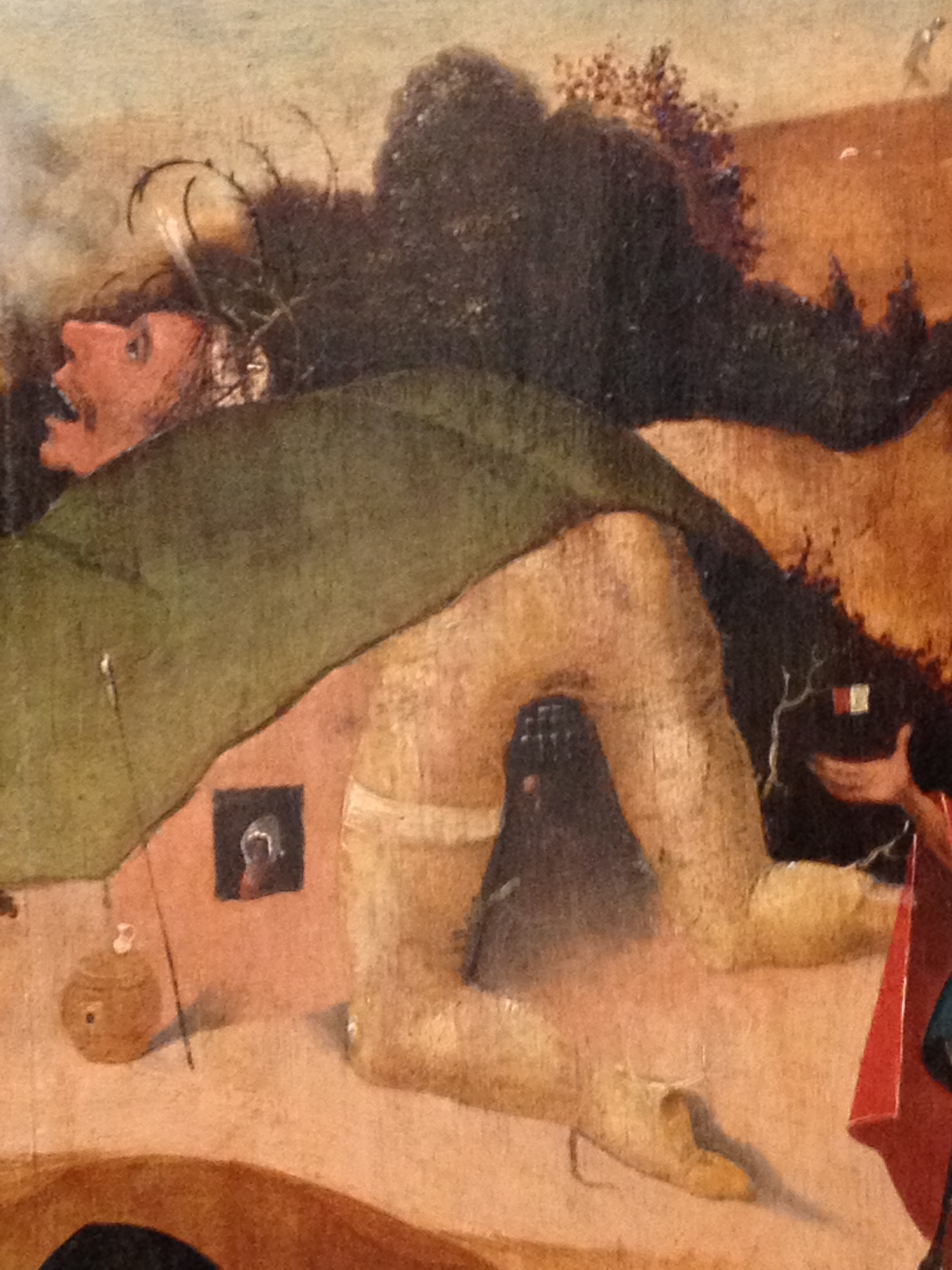
A portcullis dangling from some bloke’s arse
This is a detail from the Hieronymous Bosch triptych The Temptation Of Saint Anthony. It’s not the most fantastical or insane product of Bosch’s mind or, indeed, of this particular painting, which we saw in the Musée de Beaux Arts in Brussels. But perhaps it serves as a metaphor for how we should view any Bosch work. He presents us with an arse. Naturally, we ask, what is the meaning of this arse? And yet we are forbidden from ever knowing: our own rationality is the portcullis, blocking us from entering and exploring the insanity of Bosch. Either that, or it’s just a man bending over with the front of a castle stuck between his legs. We, and future historians, can only speculate.

Gigantic murals in unexpected places
I like the Belgians. Swathes of their capital have been utilised as canvases for street art, and yet nobody seems to mind. The most spectacular examples we saw were on an otherwise unremarkable street called Bogaardenstraat, which is about a 15 minute walk from Brussels Midi station. We looked across the road and wham! A building-sized painting of a man brandishing a gun above his head was looming over us. It made about as much sense to us as Hieronymous Bosch’s Portcullis Arse, but not to worry, because on the very same street there’s also a gigantic cartoon of a man waiting for a tram. Belgian street art: catering for all tastes.

The extravagant roof of Liege-Guillemins train station
We travelled by trains for our entire trip because we think they’re brilliant. Trains engender a sense of community among your fellow travellers and you get to have a nice view watching the landscape scroll past you. The burghers of Liege also seem to share our enthusiasm for rail travel, judging by the massive, wavy concrete and glass roof they’ve plonked on their station, which leant a sense of occasion to our journey to Maastricht on a delightfully rickety old train. And Liege-Guillemins is only the tenth busiest station in Belgium! What sits atop the busiest one – a scale model of the pyramids?

The Horse Woman Of Valkenburg
Due to booking incredibly late, the only accommodation we could find for the world championships was in a posh, expensive country house-type of hotel, which meant we got to enjoy a 40-minute walk through the grounds to the finishing circuit. Me and Littlejen always love stretching our legs, and it felt peaceful being in the middle of nowhere – until, rather excitingly, we heard the familiar sound of a bike race’s PA system booming in the distance. Also, we got to see a woman walking a small horse like it was a dog. The next day, we spotted her spread-eagled on the back of a horse. A full-sized horse, obviously. Doing it on the tiddler would be ridiculous – and possibly deadly for the horse.

A representative of the Philippe Gilbert fan club
One of the reasons why I wanted to do this trip is because I enjoy hearing Jen get her adaptable and enthusiastic Afrikaans gob around the Dutch and Flemish languages. Honestly, you should hear her jubilantly shouting “KOP VAN DE WEDSTRIJD!” when the TV cameras show what’s happening at the front of a Belgian Classic – the season hasn’t truly begun until I hear that clarion call ringing out from our sofa. Anyway, during the under-23s world championship race, Jen found herself standing in the queue for the loo on the finishing circuit, where she eavesdropped on a Dutch lady remarking in her native tongue that there were many British fans around and they all seemed to love the sport. And, indeed, there were a lot of Brits around, and a lot of them were thin fellas on bikes – which was a marked contrast to the magnificent figure we stood next to on the hallowed Cauberg the following day. Socks, sandals, fag in hand, a manly spread filling out his blue tracksuit, and a proud label emblazoned upon his cap: “FAN CLUB PHILIPPE GILBERT”. With support like that, is it any wonder the Belgian powerhouse won?


The Met Office: raining champs

August 24, 2012

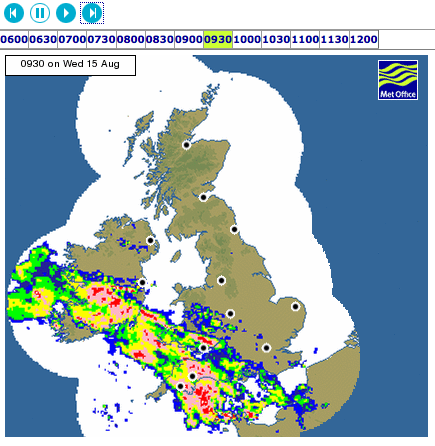
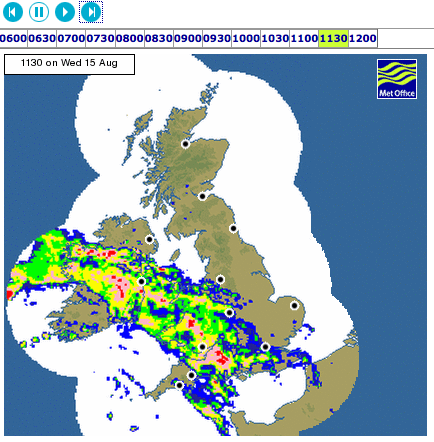
Rain clouds: they move across the sky, taunting cyclists by threatening to ruin races and training rides. But amazingly, there is a website that keeps an eye on their whereabouts. And even more amazingly, I know very few cyclists who use it.

This is not the sort of weather forecast that prognosticates in the largely meaningless form of a percentage (if you already suspect it might pour down and are trying to decide whether to go out or not, then knowing that there is, say, a 40 per cent chance of rain won’t be much help). This is a map showing, in half-hour segments, where the rain has been and the direction it is traveling, enabling you to work out for yourself if it is likely to fall upon your helmeted head should you venture out on your bicycle. I am talking about the simple genius of the Met Office rainfall radar.

Over the years, this brilliant little service has enabled me to judge whether or not to stay in and get on the turbo instead of being on the receiving end of a dismal soaking. What I like most about it, though, are the unsophisticated graphics, the bright, shifting blots representing those dark, capricious masses cruising across the sky like an invading force.

The low-tech look has been upgraded, and the old radar page will be shut down later this year. So I just wanted to offer a brief tribute to the site before it vanishes from sight, like a rain cloud.


Victory this way

August 8, 2012

There was a time when I would ride my bicycle into town, thinking that the portly physique I had in those days would never be able to convey me any further. Then one day I fell in with the right crowd (long story – I’ll tell you about it another time) and found myself doing 50-mile rides around Surrey. When you combine these two distinct parts of my life, you have, broadly speaking, the collective routes of the Olympic road races and time trials.

I witnessed parts of these races by the roadside. Jen and I walked from our flat to the mini-roundabout on Fulham Palace Road, where we cheered the men’s road race rolling towards Richmond Park like a procession of dignitaries. A few days later I watched the women’s time trial in Hampton Court. But it was seeing the roads I know well on TV that had the most impact on me.

Staple Lane’s steady ascent, the hairpins on Box Hill, the punchy little climb after Box that Gilbert was the first to tackle – they are only tarmac strips bordering fields, but these are the places that broadened my perspective on how far and how hard I am able to ride. They made me. It was like seeing your first kiss, your old friends, jobs you once had – or lost – gathered together behind the Perspex screen, depersonalised by the context of the race, and all the stranger and more moving for it.

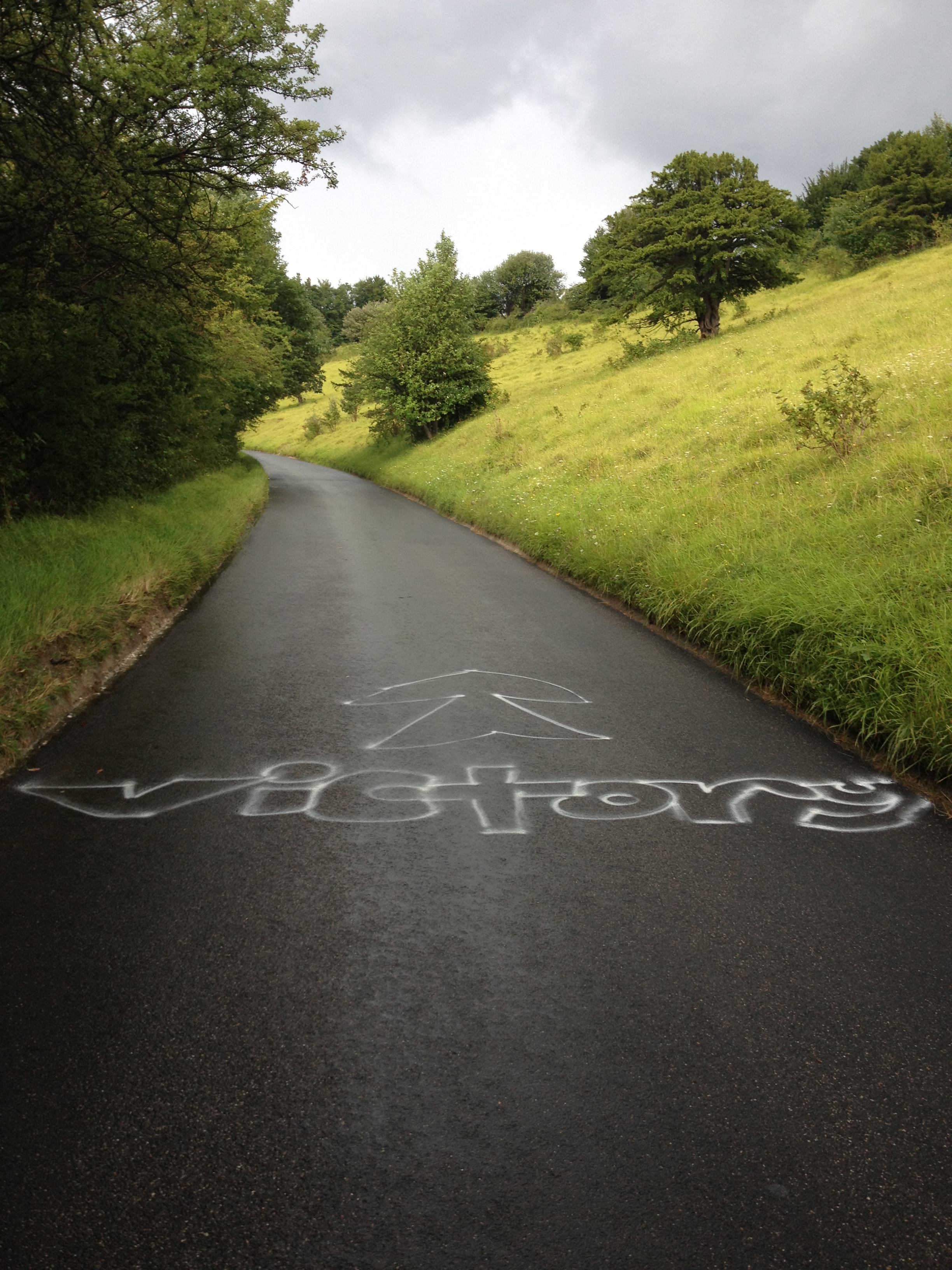
On Monday, I did my usual 70-miler through the Surrey hills. I do the same ride regularly because, regardless of whether I’m planning to race or not, losing myself for five hours a week does my mind a bit of good. I have wondered over the years why more people don’t do the same. This time, I saw the messages that fans had painted on the roads before the pros raced by. One, on Box Hill, reads: “This way to… victory”. And I like to think this kind of graffiti is a victory in itself: a permanent reminder of cyclists’ presence on these roads, and invitation for others to join us and be changed.


Bradically different

July 26, 2012

It isn’t discipline or drive which defines serious cyclists; it’s a lack of focus. You can hear it when we talk: a climb in Surrey, a mountain in France, a Tour stage from 20 years ago, last week’s chipper race – all tumble and flow into our conversations. With cycling fans, nothing is small, long ago or far away.

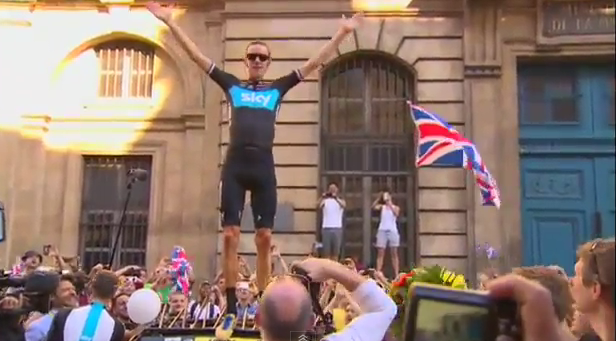
By becoming the first British rider to win the Tour, Bradley Wiggins is, to me, a living expression of this culture that expresses road cycling in all its forms, all at once. I saw him at the now-defunct Eastway circuit quite a few years ago, dressed in his Française des Jeux kit, racing among amateurs (he lapped the field and sat up, allowing the race to be decided without him). More amazingly, Jen inadvertently saw his willy as he got changed in the car park. Imagine that: a professional cyclist sticking to the age-old amateur tradition of disrobing in front of a car boot (even though Eastway was, at the time, the one circuit in London that had proper changing facilities…)

Some Tour winners are like stone icons standing upon a mountain. To me, Bradley is the boy on a poster inside the bike hut at the Hillingdon circuit, holding his winner’s bouquet. He’s the fella who conquered the mighty Pyrenees and once trained by riding up the pimple in Richmond Park. He’s here, there and everywhere – like cycling is at the moment. Like we are.