Archive for the 'Uncategorized' Category

Apple’s greatest thingamyjigs

March 9, 2012

Over the years, I have owned and used many items emblazoned with the familiar silhouette of a bitten apple. But my two favourites are probably the least technologically advanced, which is probably why their praises aren’t sung too often. So I would like to offer my own faint warble to them here.

The first device which holds a special place in my heart is this little marvel:

It looks like a Nano that’s grown a tail, but it’s actually an FM radio. Plug it into the old version of the iPod and the screen becomes a transistor receiver dial.

Now, doesn’t that look nice?

I’ve written before about my unbounded love for Danny Baker’s show on BBC London 94.9, but without this beauty, I wouldn’t be able to indulge in the simple pleasure of listening to the great man every day while I cycle into town. Having used the TuneIn app, I’ve learnt that radio via 3G is simply a means of disturbing your listening pleasure with random silences, and I’ve heard that DAB radios have the same problem. So for the foreseeable future, I’ll stick with this fantastic analogue oddity.

My second thing of wonder is the remote control for the iMac.

It enables you to adjust the volume, pause or skip tracks, and switch playlists or albums. All of which you can do with a mouse or a keyboard, but not when you’re slogging away on the turbo and you suddenly realise that you need to go one louder or change to a completely different playlist if you’re going to last until the end of the session. Essentially, by combining this simple infrared device with a pair of good speakers, you’ve turned your Mac into a less fiddly, turbo-friendly iPod.

Yes, these wotsits are merely accessories, humble sequins on technology’s shimmering raiment. But rather than launch the third incarnation of the same tablet in less than two years, I really wish Apple would instead come up with more of these unusual objects. The sort of objects that say, “I can fit neatly into your life,” not “Fit all of your life onto me.”

Downloading: the new ‘talking about stuff’.

February 24, 2012

Did you see Sebastian Coe’s brief trackside interview on Sunday afternoon after the BBC screened Laura Trott’s thrilling victory in the omnium elimination race? Or did you experience Lord Coe downloading his thoughts into your brainpiece, via your twin audio receptors (ears)? Because, apparently, it’s now perfectly acceptable to use the word in that sort of context.

Speaking about the weekend’s racing at the Pringle-roofed velodrome, TV’s Mr Olympics said the spectators would “download their experiences” of the London Track World Cup. I think he meant they’ll talk about what they liked and didn’t like about the weekend, which will presumably give his team the information they need to “upload” any tweaks that need to be made to the venue for this summer’s Games.

Watching it on telly, me and Littlejen thought the Track World Cup sounded like a right old noisy racket (and, incidentally, well done Britain for trying to rattle the cage of Germany’s Robert Forstermann by playing Queen’s us-lot-don’t-want-you-to-win anthem We Will Rock You prior to one of his duels with Chris Hoy). But there was no klaxon, ebullient roar or even a quick dong of the lap bell to signal the arrival of Lord Coe’s innovative new term for the simple act of expressing thoughts. So, like Robert Robinson introducing a new word, I hope this humble post serves as a gentle tinkle.

Not talking of Michelangelo

February 19, 2012

Last summer, I was sitting by the pool of a modest three-star hotel in northern Italy when a clubmate mentioned riding to Florence. A few dozen of us were going to participate in the Nove Colli, a 124-mile bicycle ride through the late Marco Pantani’s hilly backyard in Cesenatico, and Florence was another 90 miles away. Would I really want to sacrifice vital pool-lounging time to ride an extra 180 miles? A silly question: of course I would. We’re talking about Florence, the city of angels and gods, a place where centuries-old representations of divinity are scattered around cathedrals, churches, public squares, everywhere. It is a place of gawping and wonderment, even if you never get to see the poised, uber-human form of Michelangelo’s David in the Accademia – and clomping around a gallery in cleats is an impractical idea anyway, even if we did find somewhere safe to leave our bikes. But we’d be tired after such a long ride, and we wouldn’t have much time to spare, so I asked what in particular my cyclechums planned to see.

The answer? Nothing. The idea was just to ride there, have a coffee, and ride back again. Experiencing Florence for what it is – the world’s most abundant repository of beauty – was simply not on the agenda. But coffee was.

So if, by some miracle, this colourful fragment of the blogosphere’s fresco is being scrutinised after the apocalypse, I would like to suggest to the scholarly descendants of the few who survived that the collapse of civilization did not begin with the groan and judder of the global economy, but with the notion that we didn’t need to bother with the heart-stopping awesomeness of art; we could make do with crushed beans, boiling water and hot, frothy cow juice instead.

I realise that some of the flat white fraternity may lob the ugly accusation of anti-coffeeism at me, so let me just say for the record that some of my best friends are black-liquidistas. And, as a modern cycleperson, I have been known to happily participate in the simple post-ride pleasure of a coffee and a chinwag. But I find it baffling how drinking coffee has been stealthily elevated from banal ritual to cultural display. Plugging his new e-book in The Times last week, Will Self noted that art, film, literature and theatre once constituted culture, but thanks to an emergent interest in dining out, “all you needed to be cultured in the late 1990s was a small bowl of extra-virgin olive oil and some warm Italian bread to dab in it”. Now, it seems, the notion of culture has devolved even further: I have friends and acquaintances who talk and tweet about bean water with the same passion and enthusiasm that was once reserved for books, movies and music. In fact, I can’t recall any of them being as excited about, say, a new album or novel as they have been about a newly-discovered coffee outlet or a half-decent barista. The brewed awakening of the early ’90s, which began when American coffee shops appeared on British streets, gave us beverages that tasted better; perhaps it also inadvertently eroded some people’s willingness, in the cultural sense, to cultivate taste.

But hey, you don’t need art when just sitting in a coffee shop can make you feel all arty and creative. Chris Ward, a man who I have spent many a mile pedalling alongside on London Dynamo rides, has written a book about working from coffee shops, in which he notes that “writers, actors, artists etc don’t work in an office – so why are you?” Perhaps one response to this conundrum is that many Starbucks-bound writers would love an empty office to work in, and you can’t rehearse a soliloquy or create a sculpture in the middle of Caffè Nero. But if you want to feel really clever, why not visit Prufrock? The name comes from a T. S. Eliot poem – you know, the one that goes: “In the room the women come and go, Talking of Michelangelo.” I just hope that the eponymous narrator – a sexually frustrated social inadequate who measures out his life “with coffee spoons” – doesn’t reflect how the company views its target customer. Or maybe they’re banking on their punters not knowing too much about poetry.

As for that bike ride to Florence… well, we never went in the end. I guess the appeal of coffee, even to its most ardent fans, has its limits after all.

Cheerio, YoGymBo©

February 10, 2012

Oh, YoGymBo©, my very own purpose-built training facility! How I wish I could overcome the laws of science, practicality and building regulations that prevent me from teleporting you 400 metres down the road and bolting you onto the side of our bijou one-bedroom flat. But I can’t, for while I secretly like to pretend that the scope of my iPhone’s usefulness is a bit like that of a sonic screwdriver, I fully realise that it is not yet capable of “beaming up” matter and transferring it to a designated point. So, faced with the limitations of technology, I have packed your equipment away ready for our long-awaited move, now that the evil presence of dry rot has been vanquished from our home. And the dismantlement means you, YoGymBo©, are no longer a combined yoga area, gym facility and turbo room. You are now just a dining area with a swirly, slightly outdated carpet and a fold-up table. But myself and Littlejen shall remember you for what you once were: an innovative home fitness solution for lighthearted couples everywhere. With a candelabra. We shall never see your like again.

Today’s Times is pretty amazing

February 2, 2012

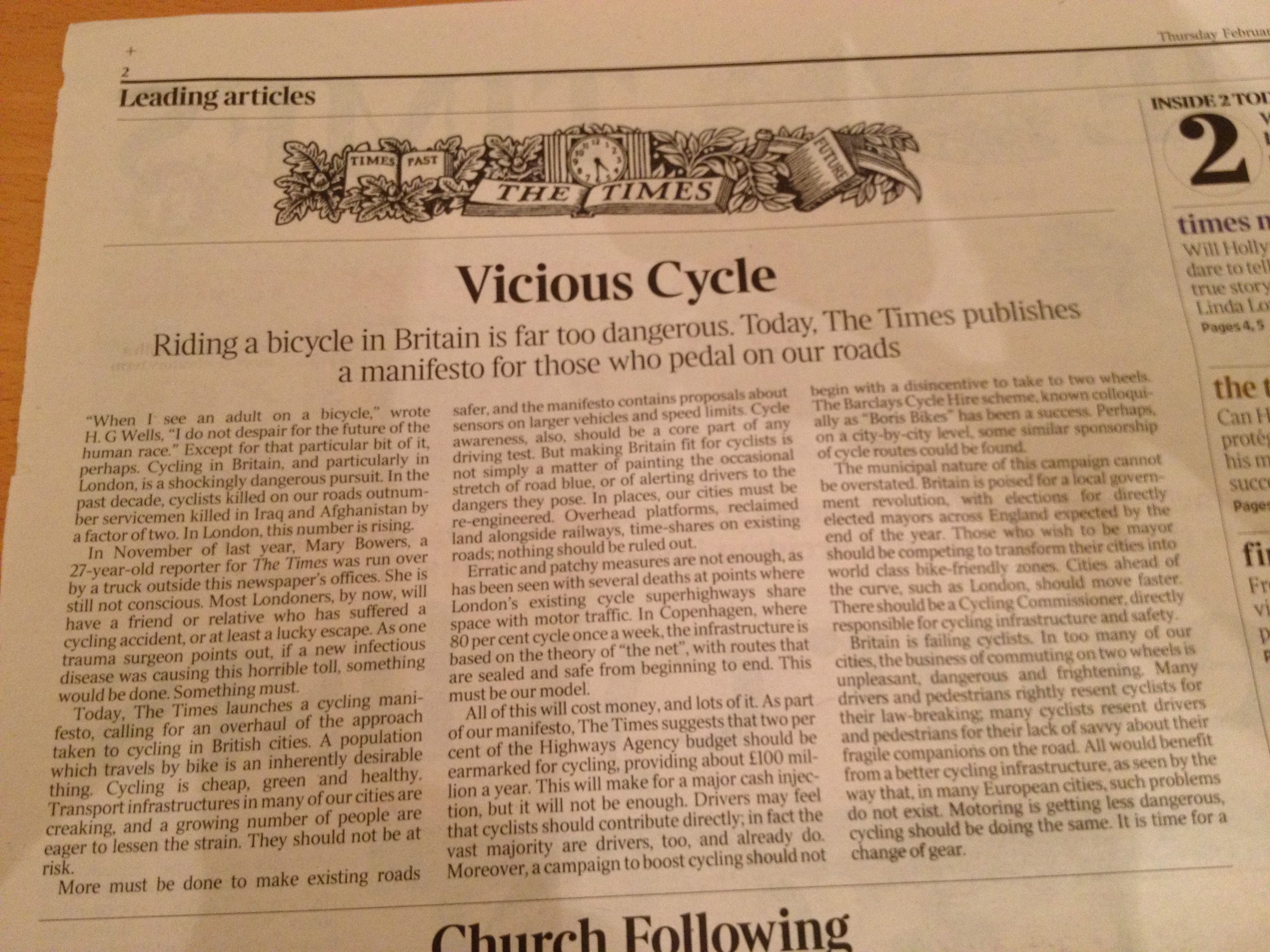
Now here’s something: a national newspaper launching a campaign to improve the safety of cycling in Britain’s towns and cities.

This is the Times’ front page:

Here are pages eight and nine:

And this is the leader on page two:

“Cities Fit For Cycling” was prompted by a road accident three months ago which has left 27-year-old cyclist and Times reporter Mary Bowers in a coma.

I’m quite impressed by what’s in today’s paper. They’ve taken a simple truth – as the popularity of cycling has increased, so too has the number of accidents – and presented a thoughtful, passionate argument without verging into an anti-car polemic. It’s going to be interesting to see what kind of impact this will have.

They’ve also liberated some of the articles from the paywall, so have a gander here and here.

Oscar Pereiro and the strange case of the unclothed, self-pleasuring policeman

January 31, 2012

Cyclepeople are polite people – perhaps too polite. Which could be why this humdinger has been cloaked in a veil of silence since the Inner Ring tweeted it on Friday. I, however, am not that mature – so I have bravely taken on the responsibility of bringing the story to a smaller, more puerile audience.

It seems Oscar Pereiro, that guy who was awarded first place in the 2006 Tour after Floyd Landis was disqualified, received a €150 fine after remonstrating with a policeman who was naked and masturbating on a beach in 2010. Feed the Spanish report into Google Translate, and it gets even more bizarre: apparently the copper’s arm was in plaster (hopefully not the one that was doing the tugging, otherwise he may have done himself a greater injury), and Pereiro claims: “He said he was a policeman and did not know who I was getting into.” They must have been standing very close together…

Perhaps it’s for the best that this chortlesome tale is likely to become largely forgotten. This wasn’t the first time Pereiro saw a scoundrel about to come first and was powerless to stop it, but he’d probably prefer to be remembered for being a winner of the Tour de France in questionable circumstances rather than that ex-bike racer who had an argument with a nude, truncheon-stroking lawman.

PSI: why?

January 20, 2012

Imagine the scene. You’re 90 miles into a 100-mile ride. Your stomach feels like it’s trying to tear through its fleshy confines in a bid to find sustenance. Then you see a fellow peddler in the distance. Slowly, you reach him and explain your plight. “Please, I’m desperate. Do you have something, anything I could eat?”

The stranger smiles. “Yes, my friend. Yes, I do have food to spare. In fact, I have 130 grams of energy bar, of which you may have half. So rejoice, for you shall now be fed.”

This, of course, would never happen. Not even the most number-obsessed cyclist would ever use grams to convey the amount of food they are carrying in their back pocket. Our fictional food supplier would say he had two bars, not 130g, even if he somehow knew the person he was talking to was also aware that energy bars typically weigh 65g.

So why, then, do we use PSI? Like sticky, packaged clumps of carbohydrate-based fuel, the pressure inside your tyres can also be measured in bars: six bar for wet weather, eight for dry or fast conditions, seven for hedging your bets. Yet typically, you’re more likely to hear fellow cyclepeople talk about PSI, the overly-precise alternative to bar.

PSI is more exact, but uselessly so: looking at the pressure gauge on my pump, I can see that the difference for 80, 100 and 120 PSI (the equivalent of six, seven and eight bar) is no less than six PSI and no greater than two. You would never notice the difference.

And as well as sounding more dweeby, “120 PSI” takes longer to say than “eight bar”. It is, quite literally, a waste of time.

Maybe the nature of the task it relates to has something to do with PSI being the more popular unit of measurement. Inflating tyres is a dull, mechanical process, and bar is a dull, mechanical-sounding word. PSI sounds clever and scientific, as if your tyres are another fancy gadget to play with, like a powermeter or GPS device. You’re pumping your tyres when you’re using bar, but with PSI you’re, er, uploading air. That’s the least dumb theory I can come up with, anyway.

One incident has given me hope that bar can make a resurgence. Somewhat behind schedule, I punctured on the way to the Hillingdon winter series a couple of weeks ago and was frantically removing the inner tube on my rear wheel when a red Mini pulled up. The door opens, and out comes a fellow Dynamo brandishing a track pump. He has one question: “Eight bar?” A short time later I’m riding again, and I make it to the signing-in desk with minutes to spare. So thank you, bar-loving ‘Mo: unlike the gram-obsessed cyclist I used for illustrative purposes, you actually exist.

A couple of reasons why the RadioShack-Nissan-YourNameHere team kit is quite fun.

January 19, 2012

They’ve kept the moob tube and made it red. Perfect for the portlier rider with a penchant for replica pro jerseys who wants to show off his “rack”.

And the underlined Leopard “O” has also survived.

So when Oliver Zaugg pins on his “1” dossards at Lombardy, he’ll be wearing an “amazedface” emoticon like Cancellara at Flanders.

Amazing.

Tesco vs Waitrose. Tesco wins.

January 10, 2012

My goodness, there’s a lot of hate around, isn’t there? So let’s start the New Year by showing some love – a lot of love, actually – for a thing that is universally reviled: the enormous Tesco on the West Cromwell Road.

Let me tell you, without a trace of irony or mischief, that I am well into this place. They sell those nice City Kitchen meals and the super-big cartons of Innocent smoothies. You have the option of buying small amounts from the meat counter instead of wastefully buying whole packs. There’s a lovely, raised, semicircular fish counter. There are self-service tills. There is easy parking. The food is cheap, and it isn’t nasty. And it’s open late at night. Man, late-night grocery shopping… When I’ve done the weekly shop at 2am, I’ve experienced the sort of exultation Michael Jackson must have felt when he wandered around Harrods after hours. Except this shop is full of stuff you’d actually want to buy, like whole chickens and re-sealable fridge packs of baked beans, rather than tweed jackets and diamond-encrusted candlestick holders (as you may have guessed, I have never shopped at Harrods).

Waitrose, where I also shop regularly, has none of these things. What it does have, in abundance, is queues. There are huge queues at the Kensington High Street branch because there are no self-service tills. At Fulham there’s sometimes a bit of a wait to get out of the car park due to the security guards checking the tickets at the gate (and, nonsensically, they angrily insist on handing back my card receipt, even though I don’t need it.) Over at East Sheen – the only Waitrose I know of that has a proper meat counter – there’s usually a long queue to drive in. This last annoyance is the most frustrating of the lot, because the Sheen branch is the only supermarket around that has trolley-mounted barcode zappers: the time you save by avoiding the checkout is wasted by waiting to drive in.

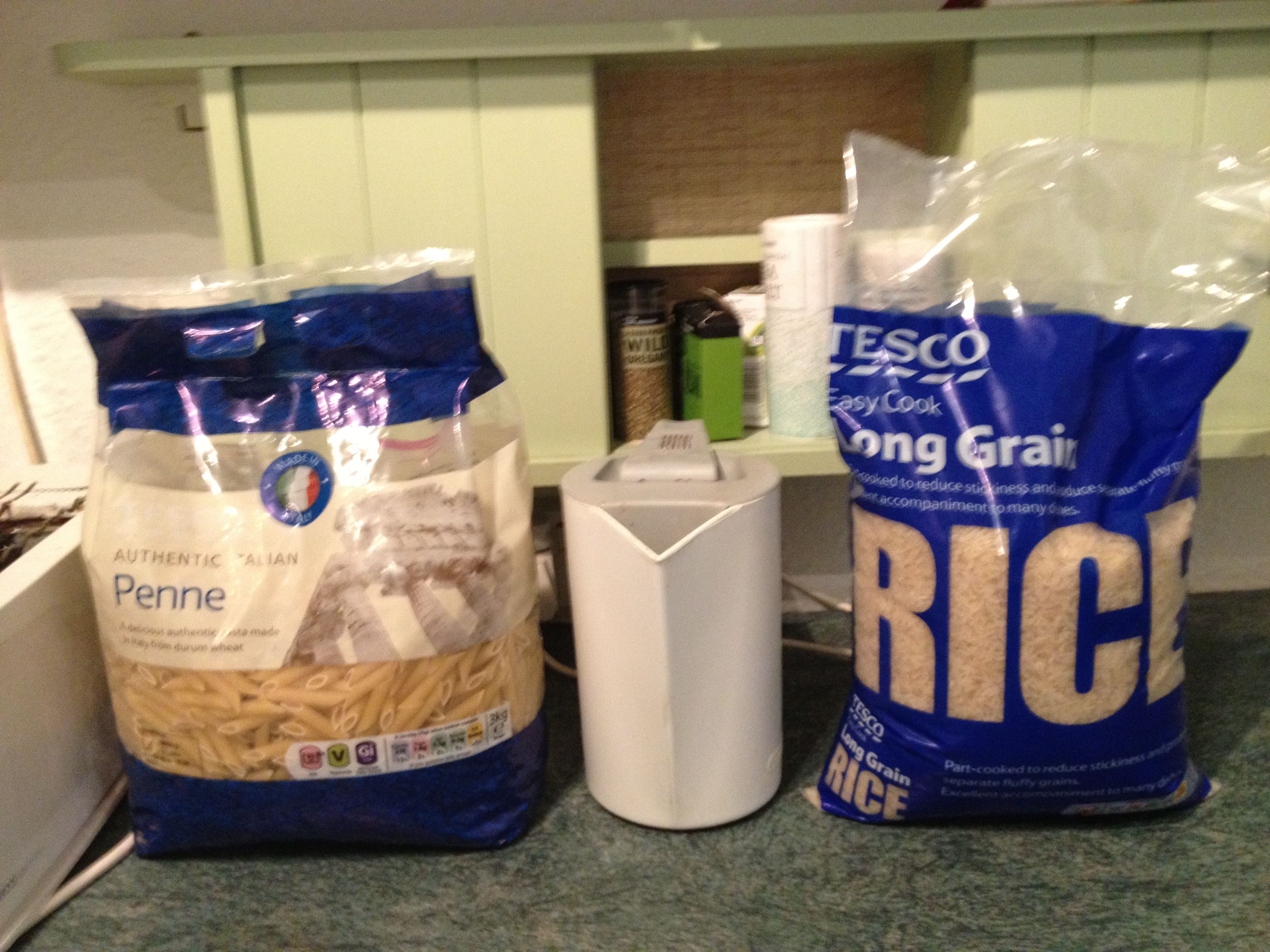
I think these are all good reasons why, from the perspective of user experience, Waitrose is PC and Tesco is Mac. But if you’re a cycleperson, there are two reasons why you should love the glass monolith glistening over the A4. The first is this: gigantic megabags of pasta and rice.

Buy them, stick them in your cupboard, and you will never go hungry after a long ride ever again. (Or just drastically reduce the chance of not having anything to eat, because even though they last longer you might still forget to replace them when they run out. Look, it’s not a failsafe system. I’m just trying to help, alright?)

The second reason is so extraordinary that you may want to ask a friend or colleague to scroll down while you hold onto either side of your head, because what you are about to see is going to blow your freakin’ mind. Seriously.

You ready? OK. Here we go…

Yeah, that’s right: FIVE DIFFERENT TYPES OF SOREEN LOAF.

BANG: Cinammon. BOOM: Fruity Five. KERPOW: Banana. Frigging banana! The cyclist’s main food group! In a Soreen loaf! Plus, of course, the classic malt loaf in sliced and unsliced formats. There is nothing more the modern cyclist could want from a supermarket.

I have had the pleasure of consuming all of these, and each one is delicious. But please keep this secret to yourself, reader. For if I turn up at Tesco at 2am and find an empty shelf in the baked goods section, I shall be heartbroken.

Let’s not shake on it

December 31, 2011

If you and I were to meet, I wouldn’t want to shake your hand. Because I’d like us to have an enjoyable time together, and shaking hands implies we’re not going to have any fun whatsoever. To me, a handshake at the beginning of an encounter means, let’s get this over with; at the end, that’s it – we’re done. A formula for formality, a handshake can extinguish a friendship before it has even begun.

It is now the season of The Handshake. Colleagues wish me a merry Christmas, or a happy New Year, or both, by offering an outstretched palm. This is when a shake of the hand becomes an expressive gesture, a means for people who aren’t quite friends to express a friendly sentiment. But during the rest of the year, I experience the mundane oddness of handshakes. I arrive at training rides or races, and cyclists – good friends, men I have known for years – offer to shake my hand, even if they last saw me only a few weeks before. It’s as if we’re pretending that these meetings are planned, when they invariably occur by chance. Or maybe, by doing something with our upper bodies, we’re each compensating for being stuck in a half-standing, half-sitting position with a bicycle between our legs.

Four months ago, I sat in on a meeting with an author and an editor friend of mine. I didn’t need to be there, but I went along because I had helped set up the meeting (I liked the idea the author had for a book and I guessed, correctly, that my friend may be interested in publishing it). The author is physically disabled, and his carer was the only woman present. At the end of the meeting, the men were all shaking hands, and I thought I’d better join in. So I turned to the carer, who was at least ten years younger than me, said, “Nice to meet you,” and offered my hand. She was taken aback – so taken aback, in fact, that she gave me what I can only describe as an ironic handshake, delivered slightly slower than everyone else’s and with a smirk. I have made it my mission to do the same at least once in 2012.